A Comprehensive Reputation & Enterprise Risk Glossary
Advertising Value Equivalency (AVE): The amount a story would cost if appearing as paid advertising. Usually, in dollars, the AVE is determined by multiplying the length of a story by the going rate for paid advertising at a particular publication.
Artificial Intelligence (AI): An area of computer science that focuses on the theory and development of computers and software with the ability to think and learn. Often referred to as Machine Learning, AI systems are trained to undertake tasks usually requiring human intelligence, such as translation, speech recognition, and visual perception. Learn more about generative and discriminative AI differences here.
AI Citations: When an AI model references a real earned media article by citing the article’s actual URL.
Battleground Topic: In Signal AI Reputation Reports methodology, these are topics that continue to be important drivers of reputation, quarter after quarter. (See: High Velocity Topics, Landmine Topics, and White Space Topics).
Boolean Search: A type of tong-tail search used in media monitoring, allowing PR professionals to combine keywords with modifiers like AND, NOT and OR to specify results and ensure relevancy. However, boolean is often a long, complex, and inaccurate process that has been superceeded by AI-powered media monitoring platforms. Learn more about AI-powered search vs. Boolean keyword search here.
Brand Image: The perception of a brand in the minds of consumers, shaped by branding, messaging, and customer experience. It’s a key component of reputation management.
Brand Mentions: Occurs when a brand name appears anywhere within an AI-generated response, whether or not it is cited as a source.
Brand Ranking: How frequently a brand appears in AI-generated responses compared to other brands within the same prompt category or topic.
Brand Reputation: The perception and trustworthiness of a brand as seen by the public, customers, employees, and other stakeholders. It encompasses the brand’s values, quality, customer service, and overall image.
Brand Visibility: The percentage of AI-generated responses in which a brand is mentioned.
Broadcast Monitoring: Broadcasting is the dissemination of programs or messages through the media of radio, the Internet, or television.
Business Intelligence: The technology-driven process for analyzing and presenting data as actionable insights to corporate end users to inform business decisions.
Business event: Events that clients in the Corporate Risk vertical require to monitor and be able to evaluate risk. Business events represent an event that happens and is published in the media, based on a particular framework for a certain indicator.
Campaign: Campaigns are the planning, carrying out, and analysis of a PR plan of action.
Chief Communications Officer (CCO): The executive role in a company that is responsible for corporate communications and company messaging, media relations, stakeholder engagement, measurement and reporting on key campaigns, and crisis management. Learn more about the Chief Communications Officer’s role here.
Chief Risk Officer (CRO): The executive role in a company responsible for leading the ERM program across an organization. Their duties include assessing, communicating, and mitigating significant operational challenges or challenges associated with competition, regulations, and digital developments.
Citation: A news article or source that an AI model explicitly references to support its response. (See: AI Citation)
Conversation: A prompt sent to an AI model and the response it generates.
Corporate Communications: Public relations for a corporation, integrated as part of a company’s strategic objectives. Corporate Communications is the strategic management of all internal and external communications within an organization. Its goal is to create a consistent corporate identity and influence public perception. Corporate communications involve messaging, media relations, stakeholder engagement, and crisis management. Learn more about corporate storytelling and ways to engage your audience here.
Corporate Compliance: The way that a company ensures that it is following all the laws and regulations that apply to their business. This generally involves the design, implementation, and monitoring of policies, trainings, procedures and practices.
Communications Management: Developing and managing communications objectives that are consistent with the organization’s overall goals. Communications managers identify relevant stakeholders and audiences and devise long-term strategies and tactics to reach them. (See: Internal Communications, Executive Communications, and External Communications).
Corporate Reputation: The overall estimation in which a company is held by its stakeholders, reflecting its ability to deliver valued outcomes to various parties. It includes aspects such as ethical standards, reliability, and financial performance.
Committee of Sponsoring Organizations of the Treadway Commission (COSO): the body that publishes the most widely adopted ERM framework.
Share of Voice: a metric used to determine how you weigh up next to your competitors. It can provide insight into how much coverage your company receives in relation to that of your competitors. A metric that will come in handy in making sure your brand stays ahead of the pack. Learn more about how to measure media coverage here.
Competitor Analysis / Competitive Intelligence: Defining, gathering, analyzing, and distributing intelligence about products, customers, competitors, and any aspect of professional context needed to support executives and managers in strategic decision-making. The Signal AI platform allows businesses to build their competitive intelligence effectively and in real-time. (See: Market Intelligence)
Copyright Licensing Agreement (CLA): A UK non-profit organization providing rights and licenses for intellectual property, simplifying copyright to make it easier to access and re-use content. The Publishers Licensing Society performs collective licensing on the CLA’s behalf. Learn more about Signal AI’s commitment to AI Ethics here.
Corporate Social Responsibility (CSR): Providing support to a cause or an event by devoting corporate resources in exchange for an opportunity to enhance goodwill. The role of PR in CSR is to communicate effectively in order to build corporate accountability and transparency.
Crisis Communication: A sub-section of public relations (PR) and corporate communications that are designed to protect and defend an individual, company, or organization facing a public challenge to its reputation.
Crisis Management: As a subset of reputation management (See: Reputation Management), establishing plans, strategies, and actions to be used when an individual, company, or organization becomes involved in a crisis or unexpected negative events that could harm an organization’s reputation. The policies and procedures for the distribution of information to employees, the media, the government and other governing bodies, and customers. Effective crisis management aims to mitigate damage and restore trust. Learn more about how to manage a PR crisis here.
Dashboard Software: Software providing at-a-glance views of key performance indicators (KPIs) relevant to a particular objective or business process.
Data Science: A multi-disciplinary field that uses scientific methods, processes, algorithms, and systems, to extract knowledge and insights from data.
Emerging Risk: A risk trending upwards in terms of activity; that is new, evolving, or not yet fully understood but has the potential to significantly impact the organisation. It is not an unknown risk, and there is likely some mitigation in place, but there has been some incident indicating this risk is getting close, e.g., a competitor or affiliate has had a cyberattack (See: Unknown Risk).
Enterprise Risk Management (ERM): A comprehensive, organization-wide, and structured approach to identifying, assessing, and managing risks that could affect and organization’s ability to achieve its objectives. ERM aims to maximize value by balancing risk and opportunity and aligning risk management with strategic objectives.
Entity Recognition/ Disambiguation: Commonly referred to as Named Entity Recognition and Disambiguation (NERD). Signal AI’s entity recognition is the process of extracting information and determining the identity of entities mentioned in text.
ESG: ESG stands for Environmental, Social, Governance. Learn more about how to use data to shift ESG perception here.
Event Detection:
External Communications: The dissemination of information from an organization to external audiences, including customers, investors, media, and the public, to build and maintain a positive reputation.
External risk: External risk for corporate risk management encompasses factors beyond the company’s control, such as economic fluctuations, regulatory changes, and market competition, which can significantly impact its operations and performance.
Focus Area: In AI Citations, a focus area is a narrow, topic-specific lens used to understand how AI models reference a brand around a particular theme. (See: AI Citations)
Generative Engine Optimization (GEO): Generative Engine Optimization (GEO) is an emerging practice focused on creating and optimizing content to be easily discovered, understood, and used by AI chatbots and generative search engines. The term is also commonly referenced as: Generative Search Optimization (GSO), Answer Engine Optimization (AEO), Artificial Intelligence Optimization (AIO), Large language model optimization (LLMO), AI Search Optimization (AISO). Learn more about what GEO means for PR & Communications professionals here.
Governance, Risk, and Compliance (GRC): Governance, risk, and compliance (GRC) is an organizational strategy for managing governance and risks while maintaining compliance with industry and government regulations.
High-Velocity Topic: In Signal AI Reputation Reports methodology, these are topics trending either positively or neutrally vs the previous quarter. (See: Battleground Topics, Landmine Topics, and White Space Topics).
Horizon scanning: A foresight method to systematically detect early signs of potentially important developments – can support policymakers and other decision-makers in anticipating future developments, managing risks, and pursuing opportunities to help build resilience to future shocks and reduce uncertainty.
Impact Score or Media Impact Score: A proprietary score of measurement to demonstrate trends in activity. The score should be relevant to a specific use case. Some of the metrics included in a reputation or media impact score are sentiment, salience, messaging, spokespeople mentions, and/or brand pillars. Combine this into a score up to 100, and you can then weigh each metric determined by the relevance to your own initiatives. This then allows you to compare directly between competitors, markets, divisions and territories.
Individual Prompts: A specific question sent to an AI model to generate a response.
Insights: The breakdown and analysis of the results of a search on the Signal AI platform, including the number of articles, potential reach over time, source location, media type, sentiment, etc. Explore our Signal AI Insights Hub here.
Internal Communications: Communicating with employees and shareholders to inform them of change (for instance, during a company merger), keep them up to date with company news and developments, or to help achieve corporate objectives.
Internal Controls: Mechanisms and procedures implemented to ensure the effectiveness and efficiency of operations, reliability of financial reporting, and compliance with laws and regulations. They play a key role in managing enterprise risks.
Internal risk: Internal risk for corporate risk management refers to potential hazards that originate within the organization, such as operational inefficiencies, employee misconduct, and technological failures, which can adversely affect its stability and success.
ISO 31000: The international standard providing principles and guidelines for risk management.
Issue Management: An ongoing activity that includes studying public policy matters and other societal issues of concern to an organization. The manager identifies relevant issues, problems, and trends and executes a program to deal with them.
Key Risk Indicators (KRIs): Metrics used to signal that risk exposure is approaching an unacceptable level.
Landmine Topic: In Signal AI Reputation Reports methodology, these are topics trending negatively with higher than average levels of negativity. (See: Battleground Topics, High-Velocity Topics, and White Space Topics).
Large language models (LLMs): LLMs are AI systems that generate answers to questions by analyzing and synthesizing information from large amounts of text. Examples include systems like OpenAI’s ChatGPT, Anthropic’s Claude, and Perplexity.
Market Intelligence: Information relevant to an organization’s market, such as trends, competitors, and customer monitoring, aggregated and analyzed to aid in determining strategy in areas such as market opportunity. Signal AI simplifies and speeds up market intelligence gathering with artificial intelligence specifically to help business leaders make smarter, faster business decisions. Learn more about how to take advantage of market intelligence here.
Media Analysis: The examination of media content to evaluate the tone, sentiment, and reach of coverage. It provides insights into public opinion and the effectiveness of communication strategies.
Media Clipping: The practice of collecting and archiving media mentions of a brand or topic from various sources. It serves as a record of media coverage and can be used for analysis and reporting.
Media Kit: A package of materials provided to the media, including press releases, company backgrounders, and images, to help journalists report accurately about an organization.
Media Intelligence: The collection and analysis of data from various media sources to inform decision-making and strategy. It includes understanding media trends, audience engagement, and competitive positioning.
Media Monitoring: Monitoring a company’s coverage in the press, on TV and radio, podcasts, and on the internet. Signal AI has automated and augmented this process using artificial intelligence, enabling organizations to monitor more than their own media coverage. Replacing long-tail boolean searches and Google Alerts, platforms like Signal AI add value to businesses’ PR efforts. Learn more about what is media monitoring and why it’s important here.
Media Relations: Setting up and maintaining a professional and mutually beneficial working relationship with the media, in part by becoming known as a credible source, thought leader, and provider of factual, expert information. In the short-term in involves dealing and communicating with the media when seeking publicity or responding to reporters’ questions.
Net Sentiment: The ratio of positive to negative coverage for a given entity. Net sentiment helps you to understand how favorably the media is covering the story overall.
Newspaper Licensed Agency (NLA): The Newspaper Licensing Agency (NLA) is a publisher-owned rights licensing and database business for UK newspapers. The NLA undertakes collective rights management on behalf of its members and licenses companies, including press cuttings agencies and media monitoring firms.
Noise: Anything that interferes with the ability to send or receive messages, usually related to radio or TV broadcasts. Noise could also refer to topics that are frequently talked about. Cutting through the noise is a key job of a PR professional.
Online Reputation Management (ORM): The process of controlling and improving how a brand or individual is viewed online, including through social media, review sites, and search engines. ORM involves responding to reviews, creating positive content, and managing negative mentions.
Persona: In Generation Engine Optimization (GEO) or LLM monitoring, a persona is a realistic type of person AI models assume is asking questions about your brand, based on their goals, context, and information needs.
PR Measurement: The measurement of PR efforts. PR professionals disagree on the best way to PR, but it is usually done through a combination of attribution, advertising value equivalency (AVE), market share of voice, and other tactics. Learn more about establishing a PR measurement framework here.
Press Release: An official statement issued to the media to announce something newsworthy, such as a product launch, event, or company milestone.
Prominence: The attention, and therefore standing, a story on an organization, brand, issue, or message gets in the media.
Prompt Category: A structured bucket of related questions about your brand that AI users commonly ask. (See: AI Citations)
Prompt Response: The answer an AI model generates to a prompt, which may include brand mentions and citations. (See: AI Citations)
Public Affairs: Dealing with and communicating with the government and groups associated with societal (public) policies, actions, and legislation. Unlike government relations, where the practitioner works strictly on behalf of an organization, public affairs also are concerned with the effect of public policies, actions, and legislation on its audience.
Public Perception: The general impression and beliefs that the public holds about a brand or organization, influenced by marketing, media, word-of-mouth, and personal experiences.
Public Relations (PR): The strategic management of the relationships between an organization and its diverse audiences through the use of communication to achieve mutual understanding, realize organizational goals, and serve the public interest.
Reach: Refers to the number of people who could have been exposed, at least once, to an article. It is the number of people who are exposed to the medium and hence have the potential to see the article.
Readership: How many unique people consumed an article.
Regulatory Monitoring or Regulatory Compliance: A continuous effort for a business to ensure that they are aware of and take steps to comply with, relevant laws, policies, and regulations. Signal AI tracks international legal and governmental updates throughout the legislative lifecycle giving you a heads-up at each stage.
Reputation Drivers: The public or target audience’s perception of a business, product, or service in terms of credibility, trustworthiness, or image. For Signal AI, the major question for reputation drivers is ‘Are we leading the conversation about the things we care about? How do we compare to others on the same topics?’ Core reputation drivers as defined by Signal AI are Purpose, Performance, Innovation. Explore an analysis of reputation drivers across 500 of the world’s most talked about companies in the Signal AI 500 here.
Reputation Management: The planning and implementing of policies, procedures, and campaigns that build public perception of a business’s reputation or demonstrate an organization’s commitment to public and social responsibility and ethical behavior.
Reputation Risk: The potential loss of financial capital, social capital, and/ or market share resulting from damage to a business’s reputation. This is often measured in lost revenue, increased operating, capital or regulatory costs, or destruction of shareholder value.
Residual Risk: The level of risk remaining after controls and mitigation measures have been applied.
Risk: the possibility of something bad happening. Risk involves uncertainty about the effects/implications of an activity with respect to something that is valued.
Risk Appetite: The amount of risk, on a broad level, an entity is willing to accept in pursuit of value. It reflects the entity’s risk management philosophy and, in turn, influences the entity’s culture and operating style. Risk appetite guides resource allocation and assists the organization in aligning itself, people, and processes in designing the infrastructure necessary to effectively respond to and monitor risks. (See: Risk Tolerance)
Risk Assessment: The process of identifying and evaluating potential risks that could negatively impact the organization, considering their likelihood and potential impact.
Risk Committee: a team put together to assist in overseeing the organization’s risk strategy and creating an effective risk management framework. Every large global enterprise has a risk committee that reports to the board.
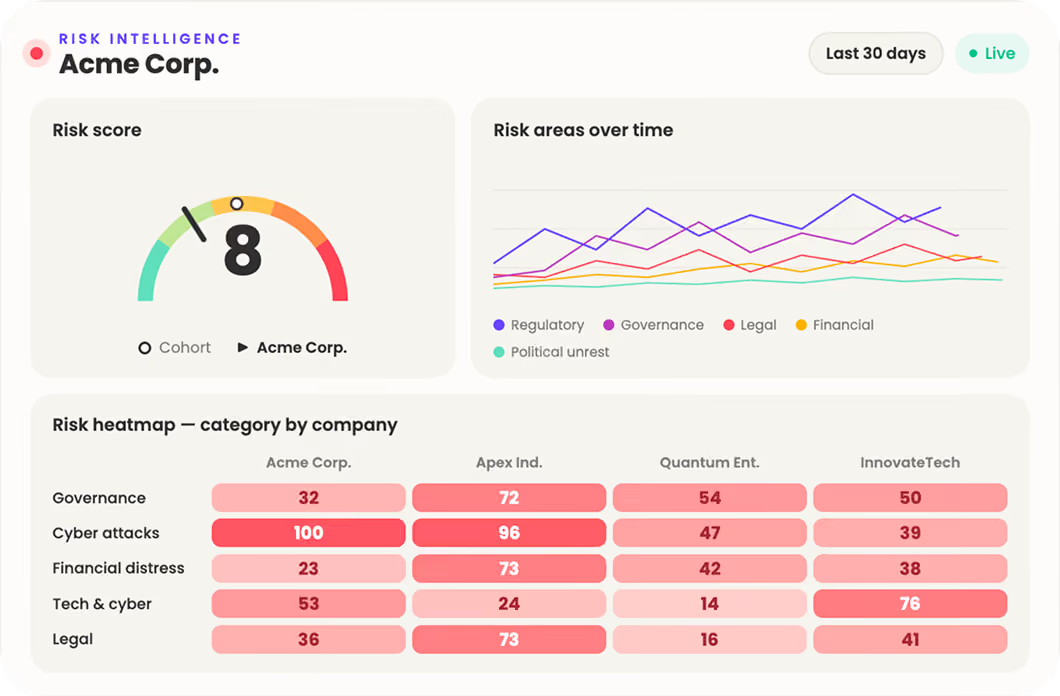
Risk Heat Map: A visual tool that plots risks by likelihood and impact to prioritise management attention.
Risk Management: Preventive PR through which an organization focuses on identifying areas of potential danger and risks and recommending necessary action before any threat develops into a crisis.
Risk Mitigation: Strategies and actions taken to reduce the likelihood or impact of identified risks. This can include transferring risk, avoiding risk, or implementing controls to manage risk. The process of identifying potential reputational risks and implementing measures to minimize their likelihood and impact. This includes proactive communication, ethical business practices, and transparency.
Risk Owner: The individual accountable for monitoring and managing a specific risk within the organisation.
Risk Perimeter: Organisations, industries, locations, and other entities that are relevant to the “central” entity in the context of risk management. Another term may be risk landscape.
Risk Radar: A visualization of risk position based on likelihood and impact. It is often seen in a 3×3 or 5×5 grid, but it can also be in a target like a dartboard.
Risk Register: A centralised log or repository of identified risks, their likelihood, potential impact, and assigned owners.
Risk Tolerance: The acceptable level of variation relative to achieving a specific objective, often best measured in the same units as those used to measure the related objective. In setting risk tolerance, management considers the relative importance of the related objective and aligns risk tolerances with risk appetite. Operating within risk tolerances helps ensure that the entity remains within its risk appetite and, in turn, that the entity will achieve its objectives.
Risk Universe: The complete inventory of all potential risks an organisation could face.
Salience or Prominence: A metric that encapsulates ‘How dominant are we in coverage?’ or ‘Are we only getting mentions towards the end of a story instead of in the opening lines?’ Salience scores how central the entity is to an article, based on mention frequency, position, and length. It’s an intensity score, not a 0 to 1 scale. Higher means more focused coverage.
Sentiment: A feeling or opinion held about something. Sentiment is used in PR as an indicator to measure the feeling or perception towards a brand, spokesperson, or topic, and is usually classed as either positive, neutral, or negative.
Sentiment Analysis: A component of media monitoring that assesses the tone of media content (positive, negative, neutral) to gauge public sentiment towards a brand or issue. On the Signal AI platform, sentiment analysis is the result of the measurement of who is influencing the story and how. Learn more about sentiment analysis in our guide here.
Share of Voice: An organization’s share of attention in the total media coverage of a product, issue, industry, cause, or topic. Share of voice is useful when researching and reporting on competitive intelligence.
Spokesperson: An expert source and representative of an organization willing to comment on a timely issue.
Stakeholder Engagement: the process of building and maintaining relationships with individuals or groups that have an interest in the organization’s activities. This includes customers, employees, investors, and the community, and it plays a crucial role in reputation management.
Three Lines Model (3LOD): A governance framework that defines roles across operational management, risk oversight functions, and internal audit.
Topic Analysis: Topic classification, or categorization, is the automatic labeling of events in a research field in a predefined set of areas of interest. Learn more about Topic Analysis here.
Unknown Risk: A new or unforeseen risk that hasn’t been contemplated and has no mitigation in place. This risk should be added to the radar, and its potential for harm or loss is not fully known.
VUCA Environment: VUCA is an acronym that stands for volatility, uncertainty, complexity, and ambiguity.
Whitespace Topic: In Signal AI Reputation Reports methodology, these are topics that drive favorability but are under-utilized. (See: Battleground Topics, High-Velocity Topics, and Landmine Topics).
Article
Beyond the Pledge: Why Climate Execution is the New Corporate Reality
The question in the room has shifted when world leaders convene in New York for Climate Week and the 2026 UN General Assembly. It’s now “what have you actually done?” rather than “what will you pledge?” Corporate climate leadership was gaged by ambition for ten years. Bolder net-zero dates, longer time spans, and larger goals. […]
Read more
Article
How to Align Communications Strategy with Business Objectives
Your CEO wants to know: What value is communications actually driving? That pressure is real. Chief Communications Officers are investing heavily in data and analytics these days, and it’s because boards are asking the same question: How do we connect what we’re saying in the media to what we’re actually seeing in the business? Revenue. […]
Read more
Article
Signal in the Noise: Tariff Refunds and the Corporate Reputation Test
Welcome to Signal in the Noise, where we show you the real-world impact behind trending news. In April 2026, the U.S. government began distributing $168 billion in tariff refunds to importers after the Supreme Court invalidated sweeping tariffs in February. Fast forward to now: August 2026 earnings season just wrapped. Major corporations across retail, logistics, […]
Read more
Article
Beyond the Pledge: Why Climate Execution is the New Corporate Reality
The question in the room has shifted when world leaders convene in New York for Climate Week and the 2026 UN General Assembly. It’s now “what have you actually done?” rather than “what will you pledge?” Corporate climate leadership was gaged by ambition for ten years. Bolder net-zero dates, longer time spans, and larger goals. […]
Read more
Article
How to Align Communications Strategy with Business Objectives
Your CEO wants to know: What value is communications actually driving? That pressure is real. Chief Communications Officers are investing heavily in data and analytics these days, and it’s because boards are asking the same question: How do we connect what we’re saying in the media to what we’re actually seeing in the business? Revenue. […]
Read more
Article
Signal in the Noise: Tariff Refunds and the Corporate Reputation Test
Welcome to Signal in the Noise, where we show you the real-world impact behind trending news. In April 2026, the U.S. government began distributing $168 billion in tariff refunds to importers after the Supreme Court invalidated sweeping tariffs in February. Fast forward to now: August 2026 earnings season just wrapped. Major corporations across retail, logistics, […]
Read more
View More