Media monitoring is a fundamental tool in the arsenal of any organization or business, regardless of its aims or goals. While Communications teams are on the front lines of media monitoring, what is monitored and what’s done with the results affects the whole company.
When done well, media monitoring significantly contributes to achieving business goals by providing insights into competitors, industries, and the broader world, as well as an understanding of the effectiveness of communications campaigns.
Media analysis and intelligence is the next step beyond media monitoring, providing more thorough and useful insights.
The success of media monitoring hinges on understanding what needs to be monitored, as well as intuitive tools that provide actionable insights. It also means setting up the right processes to ensure better analysis of insights and taking action when needed.
This guide provides PR & Communications professionals with a fundamental and comprehensive understanding of media monitoring and how to achieve this successfully.
Signal AI users make the most out of media monitoring for the whole organization. Find out how to take media monitoring to the next level in our guide.

What is media monitoring & analysis?
Media monitoring is the actual process of scouring the media for relevant coverage. In today’s world, that means scouring the fast-moving worlds of social media, the internet, as well as traditional media, including print, podcasts, and broadcast.
Media monitoring allows you to track topics relevant to your organization and industry across print, online, social, and broadcast media output. To ensure long-term success and become a household brand or big player in your industry, you need to keep track of what’s happening around you. To see a crisis emerging and protect your business from any impact on its reputation, you’ll need to monitor the media.
Analysis, on the other hand, is a two-pronged approach. It is both:
Media monitoring can be costly, time-consuming, and overwhelming without the right tools, as there is now an overwhelming amount of output to keep track of on a second-by-second basis. Appropriate media monitoring software is necessary and makes this task possible.
AI is revolutionizing media monitoring, offering a method to scan the endless stream of data from media and social media and highlight output that requires attention or that presents an opportunity. It frees communications professionals to focus on the work that truly matters, including setting strategy, making informed decisions on how to deliver it, and shaping effective tactics for implementation.
Media monitoring should be quick, easy and insightful but traditional methods can often be the opposite. Thanks to revolutionary AI technology, both of these things are possible.

Tracking & monitoring brand mentions
In today’s fast-paced business environment, monitoring both traditional and social media is crucial for protecting and enhancing your brand’s reputation. Here’s why:
The ‘how’ of media monitoring involves finding the right tools to provide the breadth of monitoring required and reporting in a way that is both accessible and actionable.
You need to be aware of media that mentions your search terms, be able to quickly assess their importance, and determine whether they require action or create an opportunity.
Monitoring media coverage begins with the question “What should I monitor?” To find that answer, it’s best to collaborate with your C-suite and the wider business to maximize the value of media monitoring for your organization.
Comms teams should go beyond just monitoring for their own brand name and mentions of senior leadership and key spokespeople. Media monitoring is about more than just focusing on efforts to assess brand reputation, while that still has an important place.
For example, media monitoring can highlight:
PR monitoring is the act of tracking and recording mentions of your brand and key people or spokespersons within your organization.
It’s how comms teams stay up-to-speed with how and where a brand is appearing and to begin the process of analyzing if the sentiment around it is positive and likely to contribute to organizational goals.
Key PR metrics form part of PR monitoring, but comms teams have an opportunity to add further value to their organization by seeing beyond those. Offering deeper insight into the actual impact for a business when its ‘Share of Voice’ is higher than that of its competitors, for example. That can mean liaising with colleagues and other departments who hold different data sets to demonstrate, perhaps, that sales peak when the share of voice is high.
Additionally, PR monitoring that stretches beyond the usual, albeit important, function of PR teams to look further into what is going on in the wider world, and the world of competition or emerging markets, will provide added value.
As Benjamin Thiele-Long, director of global communications agency Cognito, explained:
PR monitoring and specifically reporting can sometimes overwhelm PR professionals, drastically reducing the amount of time available for them to be truly strategic and have a real impact. It’s vital to find a method that solves that problem.
Lauren Jane Heller, Director of Communications at venture capital firm Real Ventures, has described how using AI for monitoring was the answer for her. It allowed her to have confidence that nothing would be missed while also creating time for her to redirect her own efforts into more valuable tasks.
Broadcast monitoring is necessary to gain a comprehensive and well-rounded insight into all content relevant to your industry and brand, as it appears on TV and radio.
In the same way that social media monitoring is as vital as traditional media monitoring for communications teams, broadcast monitoring is equally crucial. Without it, you can never have a full picture of threats and opportunities, and PR campaign achievements will be missed.
We delve into how an AI-powered media monitoring tool can help elevate the work of PR from the tactical to the strategic in the four key areas of responsibility:
Proactive reputation management
Reactive reputation management
Horizon scanning
Performance measurement and stakeholder reporting

Media analysis & reporting
An effective media coverage report is about showing the outcome and impact of communications, rather than just a summary of mentions.
While benchmarking your media coverage is also likely to have some value, a report should demonstrate far more than just a list of vanity metrics such as coverage achieved, click rates, social media mentions, and reach of communications.
Then, it needs to go beyond that into sentiment analysis, both of the coverage in question and the resulting conversations. The next stage is to show what has actually been learned or gained as a result of media monitoring and communications functions. Did your recent campaign get coverage for the right reasons? Has an announcement about a new board member been met with positivity or negativity? How does that compare with your competitors and peers?
Beyond media coverage reporting, a media monitoring report that also provides alerts on the wider industry and related news will add more value to the organization as a whole, allowing communications teams to offer real strategic value.
This webinar, featuring Nicholle Manners, Vice President of Communications Intelligence at Prudential Financial, Stacy Ries, Vice President of Global Communications at SAP, and David Benigson, CEO at Signal AI, explores how to leverage PR measurement and analytics to drive impactful communications strategies that are indispensable to senior stakeholders.
For comms teams, analyzing media output is crucial to understanding the sentiment of conversations around your industry and brand, key topics of the moment, and the tone of discussions.
All of these things are vital not just for assessing your own communications activities, but also for planning future strategic campaigns, keeping the C-suite well-informed, and identifying opportunities and threats.
Media analysis begins with a robust media monitoring system to ensure you capture and remain alert to all that is being said. Media monitoring itself brings many benefits.
A useful analysis of media to reflect how an organization is perceived requires a solid foundation in strategy. Goals should be set that are SMART (specific, measurable, attainable, relevant, time-limited). Without these goals, it’s hard to know what you’re analyzing the media for.
Defining a PR strategy aligned with company objectives will enable the most effective use of media monitoring, providing results that benefit other departments beyond just Communications. But first, you have to select the right metrics to analyze.
Some things to consider when seeking to achieve effective media analysis are:
It’s vital to have a process for quick analysis to allow immediate response and action where that’s necessary, as well as more long-term reporting to assess the benefits of PR activities and plan future campaigns.
In our webinar on building a global measurement programme, Chichi Osuagwu describes how media coverage reports and M&E frameworks were achieved in her role as Communications Officer at the World Bank Group.
Watch Chichi’s webinar on establishing a global PR measurement framework and learn how to achieve buy-in from multiple stakeholders.
Media monitoring tools
Media monitoring tools are the apps, software, and methods used to scour traditional, broadcast, and social media for relevant news, stories, and discussion.
Where once Google alerts, Boolean strings, Twitter alerts, and cutting services were the only options. Now, AI has made things more sophisticated.
Often, PR & Comms teams focus media monitoring efforts on recording and staying abreast of owned brand mentions, spokesperson quotations, and coverage, as well as the overall reception of this messaging. That is important, but only part of the power of media monitoring.
Those who really harness the full potential of media monitoring understand the value to their organization of casting the net wider and keeping on top of their industry, competitors, and relevant global or regional news, too.
This insight can help organizations to:
Joy Frascinella, Head of PR at Principles for Responsible Investment’s, says media monitoring “really gives you a voice.”
When discussing how to turn media monitoring into intelligence, Joy described the importance of real-time media monitoring and how it allowed her organization to:
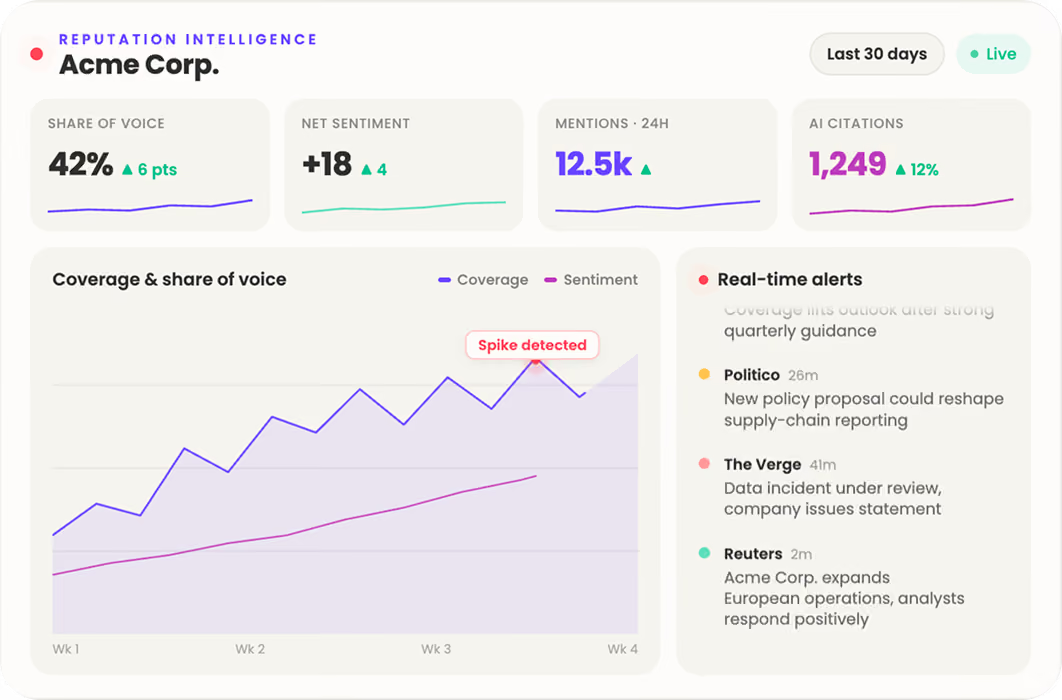
Essential enterprise media intelligence features include real-time alerting capabilities, customizable dashboards with visualized analytics, and AI-powered sentiment analysis.
Look for platforms that offer cross-company insights, portfolio monitoring capabilities, relationship mapping between entities, and executive-ready chart snapshots that can be shared with C-suite stakeholders for strategic decision-making.
When seeking a media monitoring tool, features to consider include:
The most notable free media monitoring tool is Google Alerts. Google Alerts will return results for simple terms via a regular email. It cannot distinguish between search terms such as ‘apple’, the fruit, and ‘Apple’, the brand, and can therefore return excessive irrelevant results.
Google Alerts isn’t a real-time tool either. Results are received at intervals and need to be processed to find relevancy. Then, they need to be manually reviewed for sentiment before action can be considered and taken, if necessary. Google Alerts will only report on web-based news, not broadcast coverage.
Free tools generally offer limited functionality. As these tools can be time-consuming, they often carry hidden costs in terms of inefficiency.
Inefficient media monitoring tools require more staff to keep up with search results and interpret their meaning. The overwhelming and time-consuming nature of reviewing what a media monitoring tool uncovers may lead to missed opportunities.
An effective tool needs functionality to identify and prioritize the things that require the most attention. Similarly, threats may not be responded to quickly enough with free, inefficient tools. The issue could escalate if the tools fail to help PR and communications teams identify high-priority results.
Signal AI’s platform helps PR & Comms professionals reduce the time it takes to perform time-consuming tasks, such as monitoring key publications or building coverage reports.
Other features include:
A number of paid tools offer limited free trials or entry-level packages. Not all cover broadcast, print, and web media coverage. There is often a limit on the number of terms that can be monitored within basic packages, and upgrading to include more can be costly.
Signal AI is a comprehensive strategic PR and communications solution providing a real-time overview and insight into the world’s print, online, and broadcast media.
It’s a premium media monitoring tool that significantly streamlines the process of staying informed about relevant news. It provides valuable insight to support strategic communications, reputation management, media planning, crisis communications, market intelligence, and internal reporting.
AI takes all the hard work and slog out of media monitoring, allowing communications professionals to focus on the things that really matter, such as media relations, strategic planning, and tactical steps around reputation and crisis management.
In addition, unlimited search terms and at-a-glance reports, including sentiment insights, allow PR teams to increase their value to an organization by supplying up-to-the-minute industry insights and information to support regulatory compliance.