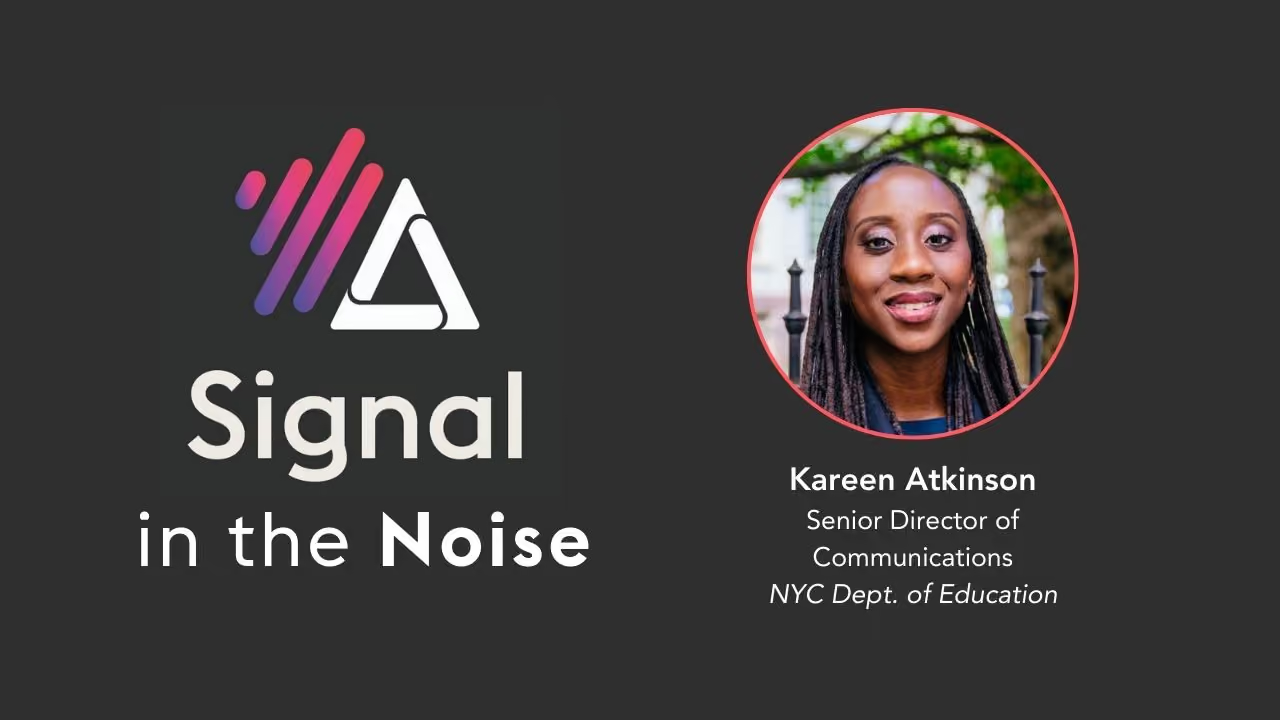
This episode features Kareen Atkinson, Senior Director of Communications at the New York City Department of Education. We dive into her career arc and how that’s evolved into her expansive role at the DOE. We also discuss the marriage between internal and external comms and how her team cascades a message across a myriad of audiences; a PSA for why every Communicator needs to read more to expand their perspective; and the value of ‘range’ and agility for creativity and diversity of thought.
Signal in the Noise is hosted by Daniel Gaynor, Head of Strategic Solutions at Signal AI.
Below is just a snippet of the conversation. For more episodes, check out the Spotify channel to listen or the YouTube channel. This transcript has been edited for length and clarity.
“It's incredibly important for comms professionals to have a large degree of range in order to do the job successfully, [which is] the life experience you bring to the work.” - Kareen Atkinson
Dan Gaynor: Kareen, you are the Senior Director of Communications for the New York City Department of Education. I can imagine your role is some parts education policy, some parts politics, some parts crisis comms. Before we get into the day-to-day of your job, how has your background of actually being in the classroom shaped how you do your job at the enterprise-wide level?
Kareen Atkinson: Two things I'd like to talk about in terms of that question. I think it's incredibly important for comms professionals to have a degree of range, a large degree of range in order to do the job successfully. What I mean by that is the life experience you bring to the work. I'm not just professional experience, but everything, right? And I think that range could be created, but in order to do this job well, you really have to sit in the seat in a way that allows you to scan the horizon and really be able to connect the dots in ways that many people that sit in one particular set of function within the organization, it's a little bit more difficult for them to do.
This particular work could be called the nucleus of communications regarding the DOE. You get a bird's-eye view every day that allows you to connect the pieces and deliver on the narratives set by the leadership.
“As comms professionals, we often think about the signals we get outside the organization... But a lot of the time, the signals we're picking up externally started internally. The question is, how are we plugged in internally within the organization?” - Kareen Atkinson
DG: In doing that, you're almost like a news anchor who does breaking news, which is always famously in the news business, the toughest thing to do because you need to have in the back of your head this encyclopedic library of context that you can use to respond quickly to what's before your eyes and in your situation, I can imagine you tap into your variety of experience, both on the media side and the corporate side, but also in the classroom side to adjust with agility to any variety of curveballs thrown your way.
Kareen Atkinson: Absolutely. I like that you use that word. I think that within this role, you have to have a high degree of agility, right? It's not the kind of function where you could think about how efficient I can be today because there are just so many things that are outside of your control every single day. You really have to be flexible, you really have to be responsive, and you really have to be plugged in, not just to what's happening in your external environment, but what's happening internally in the organization.
As comms professionals, we often think about the signals we get outside the organization. Where can we see the signals in the press? And yes, that is true. We need to know that. But a lot of the time, the signals we're picking up externally started internally. The question is, how are we plugged in internally within the organization? And where do you have that marriage between internal and external comms? It allows you to identify those signals as they're getting louder, those sonars, right? They can start somewhere that is like you just wouldn't believe at a level that has nothing to do with where leadership sits.
Then, in a few months, that became like this external noise or external high-level signal, but it really started internally. That's why I think that with this role, it really is critical to look at comms and think about not putting internal comms on a backseat but really thinking about how to elevate that and look at internal comms and understand its role. It really allows you to foresee what will become your external environment, which you will undoubtedly be responding to.
“The data is essentially talking to the audience... they're telling you so much in terms of their behavior. If you look at [the data], you're really in constant communication.” - Kareen Atkinson
DG: You work at such a big organization that it's essential that everyone aligns internally around a certain set of metrics. With a vast amount of data at hand, including internal data and external signals, let's talk about metrics and measurement first. How do you determine your approach to determining and deciding your priorities? And where do you apply this data internally to make decisions?
KA: That's a great question. We amass a lot of data in regard to principals and superintendents. How they consume information. When do they read this information? What messages are they tuning into? So you may have a message that 3,000 people read in the morning versus 600, right? What is the difference between those messages and why does one resonate more than the other? And it's not a matter of importance, but it could just be if they really, really need this information to run their schools and support schools. And you're naturally going to have a greater interest in it. It's not necessarily work all the time where you're telling stories for interest.
It's really about crafting and sharing those policies and operational updates that they need to run their schools and do their work. So in terms of data, we just pull a lot of data from even Microsoft and the tools that we use and really use that to better deliver when information is shared with them, how it is shared with that group or not just with that group and ensuring that it meets the needs of the target audience and the other stakeholders as well.
...
A lot of the data is shared with divisions so they can understand how their messages are resonating because they don't know, right? Once that information is crafted and where our team is delivering it, then you have to be the one to kind of say, okay, well, this is how that landed based on the metrics that we do have. From year to year, we share that information. We have tools that we've developed through SharePoint platforms that allow people to kind of see how their messages function over the course of a year. Cyclically, and then they can use that essentially to plan their communications from year to year, and that's largely how we use that data set to determine what you're delivering, how it is being delivered, and whether you are really serving that audience.
The data is a way to where you're essentially talking to the audience. Right? They're not really talking to you, but they're telling you so much in terms of their behavior. When do they read it? When do they open it? How long are they on this particular type of content? If you look at it, you're really in constant communication. That's how we approach data in determining what best suits the different stakeholders that we serve.
----
Signal in the Noise is a podcast dedicated to helping today's business leaders navigate the complexities of decision-making by leveraging data and groundbreaking technology—first and foremost, artificial intelligence (AI). You can also watch the interview on our Signal AI YouTube channel here.