
Article • 14/11/2023

Key Stories: How does clustering work?

Key Stories is a feature of the Signal AI platform that identifies and clusters together similar articles (even when they’re not exact syndicates) in real-time to help you quickly understand what storylines have been driving trends in data without needing to sift through thousands of individual articles. How does it work?


Step One: Entity & Topic Extraction

At its core, this capability relies on entity extraction—one of Signal AI’s fundamental features that powers much of the platform’s advanced analysis.

In this process, Signal AIQ, the AI-powered engine behind the Signal AI platform, comes in to perform Knowledge Extraction. Using AI, unstructured, messy content is transformed in real-time into thousands of searchable Concepts, which are made up of Topics like Sustainability and Automation and Entities such as Organisations, People, and Locations.


Step Two: Co-mention monitoring & Similarity Detection

AIQ then counts the co-mentions between every entity and topic in the platform and monitors them over time. Key stories identify and focus on spikes in co-mentions. By doing so, we cut through the noise, overlooking trivial news such as daily stock ticker announcements. This process distills down about 5.5 million news stories a day to about 150k spikes in co-mentions a day instead, saving you valuable time.

When AIQ identifies a spike in co-mentions, it analyzes the text of all the articles in which an entity and topic have been mentioned together and begins to decipher the underlying story driving this coverage by understanding what other entities and topics are mentioned and how similar the text is for each story.


Step Three: Story Clustering

Once AIQ has clustered together all of the similar coverage and identified the topics and entities, this distilled information can be used to quickly identify the most important coverage and underlying narrative impacting a brand. This information is presented in various ways throughout the Signal AI Web App.

  1. Through a key stories search: Rather than sifting through 13k articles about Tesla and cyber trucks, you can quickly understand, in the example below, the biggest story driving coverage on Oct 6 was Tesla cutting the price of its cyber truck.
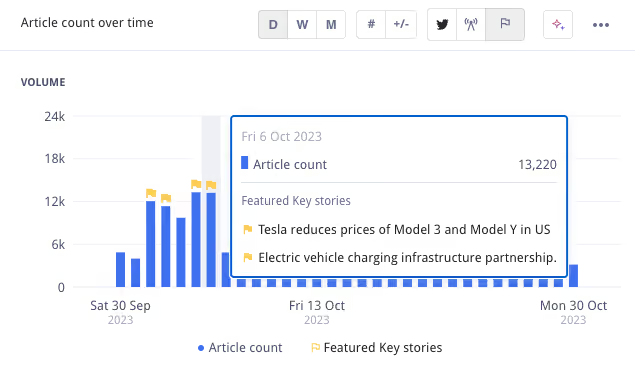
  2. Through dashboards and insights: Understand what storylines have been driving trends in data – identify instantly what’s driving the spike or drop in coverage without needing to sift through individual articles.
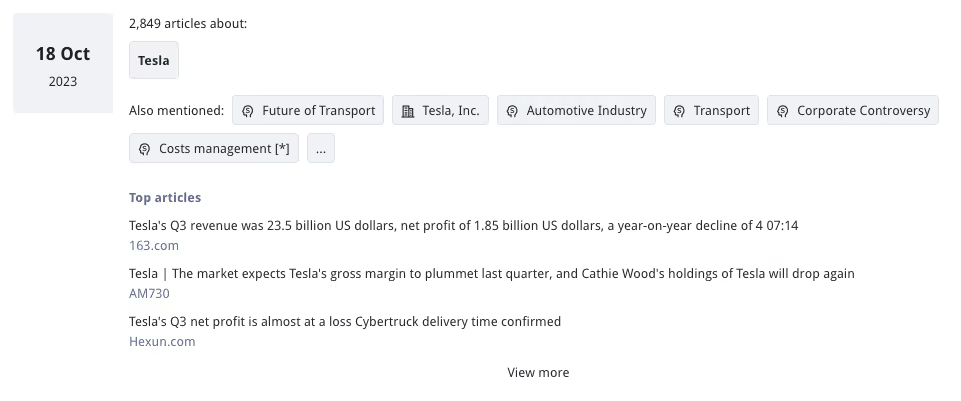
  3. Through Topic Analysis: Topic Analysis allows you to Map your Topic Landscape and discover how closely associated your business or your competitors are to the topics that you care most about. With a single click, you can dive deeper into the key stories that are driving that association.


Cut through noise. Find the signal.

Most newsletters tell you what happened. We tell you why it matters to your brand’s bottom line. Get proprietary data and strategic "Now What" insights delivered bi-monthly to help you navigate global reputation and risk.

You may also like

View More
Article

Beyond the Pledge: Why Climate Execution is the New Corporate Reality

The question in the room has shifted when world leaders convene in New York for Climate Week and the 2026 UN General Assembly. It’s now “what have you actually done?” rather than “what will you pledge?” Corporate climate leadership was gaged by ambition for ten years. Bolder net-zero dates, longer time spans, and larger goals. […]

Read more
Article

How to Align Communications Strategy with Business Objectives

Your CEO wants to know: What value is communications actually driving? That pressure is real. Chief Communications Officers are investing heavily in data and analytics these days, and it’s because boards are asking the same question: How do we connect what we’re saying in the media to what we’re actually seeing in the business? Revenue. […]

Read more
Article

Signal in the Noise: Tariff Refunds and the Corporate Reputation Test

Welcome to Signal in the Noise, where we show you the real-world impact behind trending news. In April 2026, the U.S. government began distributing $168 billion in tariff refunds to importers after the Supreme Court invalidated sweeping tariffs in February. Fast forward to now: August 2026 earnings season just wrapped. Major corporations across retail, logistics, […]

Read more
Article

Beyond the Pledge: Why Climate Execution is the New Corporate Reality

The question in the room has shifted when world leaders convene in New York for Climate Week and the 2026 UN General Assembly. It’s now “what have you actually done?” rather than “what will you pledge?” Corporate climate leadership was gaged by ambition for ten years. Bolder net-zero dates, longer time spans, and larger goals. […]

Read more
Article

How to Align Communications Strategy with Business Objectives

Your CEO wants to know: What value is communications actually driving? That pressure is real. Chief Communications Officers are investing heavily in data and analytics these days, and it’s because boards are asking the same question: How do we connect what we’re saying in the media to what we’re actually seeing in the business? Revenue. […]

Read more
Article

Signal in the Noise: Tariff Refunds and the Corporate Reputation Test

Welcome to Signal in the Noise, where we show you the real-world impact behind trending news. In April 2026, the U.S. government began distributing $168 billion in tariff refunds to importers after the Supreme Court invalidated sweeping tariffs in February. Fast forward to now: August 2026 earnings season just wrapped. Major corporations across retail, logistics, […]

Read more
View More