The question in the room has shifted when world leaders convene in New York for Climate Week and the 2026 UN General Assembly. It’s now “what have you actually done?” rather than “what will you pledge?”
Corporate climate leadership was gaged by ambition for ten years. Bolder net-zero dates, longer time spans, and larger goals. That time has passed. This year’s sessions in New York are focused on a single, more difficult topic after ten years of declarations: the discrepancy between what businesses have promised and what they can demonstrate.
That shift matters because greenwashing has crossed a line. What was once a soft reputational worry is now a material legal and financial risk. Consumers, investors, and regulators are actively enforcing accountability, and high ambition, on its own, has stopped being a safe communications strategy. Climate strategy has quietly become a reputation-management discipline, and the evidence points one way: execution is what moves the needle.
The Execution Gap is Costing Brands Trust
Despite a decade-long wave of pledges, most transition plans still lack the depth and capital reallocation needed to hit real-world targets. The numbers are stark:
- The Net Zero Tracker’s 2025 Stocktake found just 7% of companies meet the basic “starting line” integrity criteria for a credible target.
- The Transition Pathway Initiative found 98% of companies lack credible plans to shift capital away from carbon-intensive assets.
- Consumer trust is thinning: 55% of consumers say they only sometimes accept a brand’s sustainability claims, and 25% say they never trust them.
- That deficit has a price tag. 39% of consumers have already switched brands for better eco-friendly packaging.
There is no doubt about the direction of travel. Pledges by themselves are no longer trustworthy, and they are becoming more and more scrutinized.
The Reputational ROI of Action Over Intent
We divided media coverage into two categories—intent (pledges, aims, ambition) and execution (delivery, verifiable results, real change)—and examined sentiment and coverage across 50+ brands and seven sectors over a six-month period in order to calculate the true cost of that scrutiny.
The conclusion was clear. Execution coverage produced significantly greater net sentiment than intent coverage in every area. The swing is both spectacular and steady:
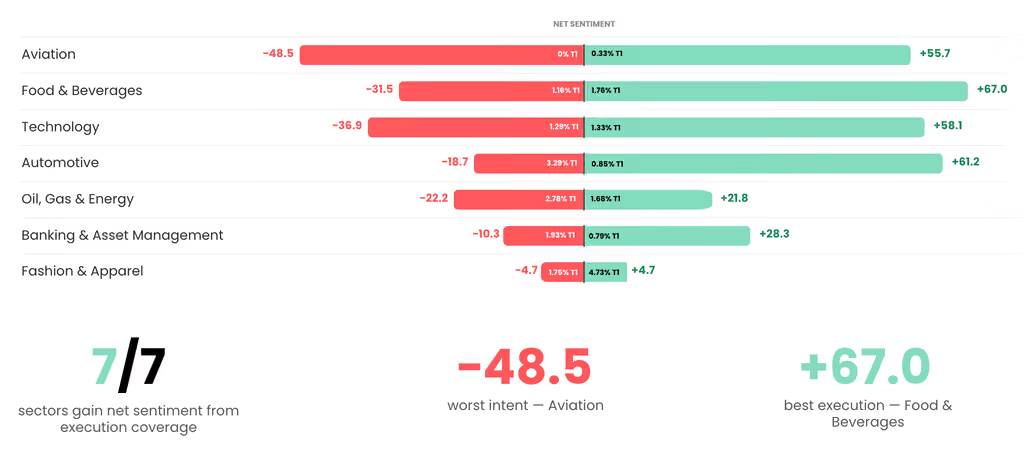
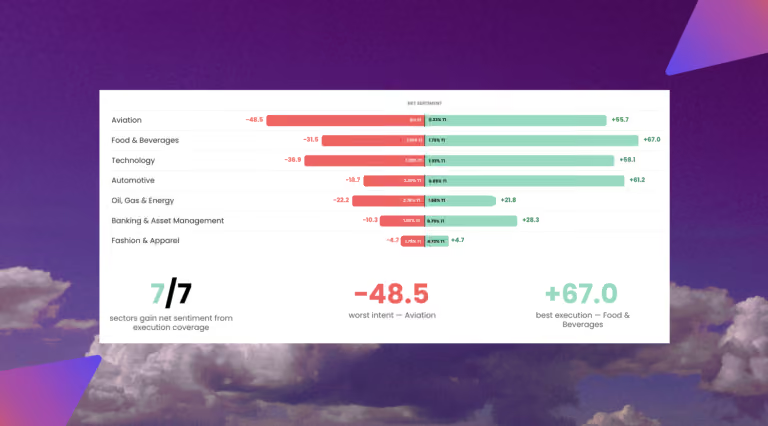
The cautionary story is aviation, which had the lowest net sentiment in the study (−48.5) due to its reliance on intent-based messaging. However, when coverage shifted to what it was really doing, the same sector had a drastically positive (+55.7). By basing its narrative on operational evidence, Food & Beverages achieved the highest execution score of any sector (+67.0). In addition to preventing backlash, turning a promise into a tangible outcome fosters the kind of trust that increases market share and pricing power. Pledges that are empty have the opposite effect.
What Backfires: The Danger of “Buying Indulgences”
The way a brand responds to a shortage depends on how it manages it. The response is consistently intensified by subtly reiterating an old target or by fronting a fancy campaign with a celebrity and no numbers.
Reliance on donations and carbon offsets is the sharpest failure mode. The sentiment data indicates that offset-led messaging is driving scores further below rather than back toward neutral, and the public and media are increasingly interpreting offsets as purchasing indulgences—paying to appear green rather than reducing your actual emissions.
The classic example is early 2026 European aviation. Airlines marketed individual tickets as “neutral,” encouraging customers to purchase offsets or chip in for sustainable aviation fuel at the point of sale. A Danish court fined KLM €401,000 in March 2026 for engaging in dishonest business activities, finding that the airline had misled passengers while using fossil fuels. It didn’t end there. By June 2026, 21 major European airlines, including Lufthansa, KLM, Air France, and others, had been compelled to legally abandon their claims that flight emissions could be “offset” away by the European Commission and the Consumer Protection Cooperation Network.
Additionally, the regulatory floor continues to rise. Offset-based “climate neutral” and generic green claims are completely prohibited by the EU’s Green Transition regulations as of September 27, 2026, with fines of up to 4% of yearly turnover. Not only is the defensive offset playbook working poorly, it is also being prohibited.
The Trap on the Other Side: Staying Silent
Many businesses are tempted to say less when faced with that risk, “greenhushing” their way out of the spotlight. Approximately 87% of companies are either expanding or maintaining their ESG investment, yet over one-third are purposefully speaking less about it.
It is not a real safety. Silence gives the story to detractors and loses the trust that supports long-term brand value. Going silent or making too many claims are risky. Focusing on execution makes it feasible to follow through honestly and confidently, which is the only long-lasting stance.
Four Rules for Earning Trust
The strongest-performing brands in the study share the same habits. Four of them do the heavy lifting.
1. Display results that have been independently validated. The largest believability signal we measured was external validation. The “marking your own homework” criticism that subtly undermines the majority of sustainability claims is neutralized by SBTi-approved targets, CDP disclosures, and third-party audits. The announcement’s credibility is enhanced by naming the verifier.
2. Make the evidence observable and palpable. An invisible backend win is not nearly as effective as a change that customers can perceive. Our data shows a stark contrast: Patagonia achieved a true engineering milestone in the spring of 2026 with a line that was 94% recycled polyester and completely free of PFAS, but the victory was hidden on the tag and ended up at +39.3 net sentiment. By linking operational achievements (100% zero-waste-to-landfill, third-party confirmed) to something consumers can handle—95% of its packaging is now recyclable or reusable—General Mills achieved a flawless +100. Very different amplification in the same category.
3. Take the lead with specific intermediate benchmarks. Now, distant 2050 ambitions are perceived as evasion. “40% by 2028, audited annually” is an example of a near-term commitment with dates and capital that reads genuine, whereas “we remain committed” is spin.
4. Reach the goal ahead of schedule. Reaching a milestone on schedule is not always noteworthy. Delivering too much does. Years ahead of schedule, General Mills’ regenerative-agriculture program surpassed 75% of its 2030 target, creating a new, positive news hook that a timely, box-ticking outcome would never have.
The bottom line
Ambition is no longer a defining characteristic of climate leadership in 2026. It is determined by the caliber of its execution. Brands that are producing genuine reputational returns have shifted from using climate promises as a platform for public relations to one that is verifiable, visible, and defendable to regulators, non-governmental organizations, and adversarial journalists alike.
The promise period is past, as the discussions in New York make clear. The era of proof has arrived.