
Welcome to Signal in the Noise, where we show you the real-world impact behind trending news.
Some PR crises begin with an obvious misstep. Others start with a decision that seems harmless, happens outside the communications team, or only becomes problematic once the public sees it.
That’s what caught our attention this week: three very different controversies, each revealing a different way reputational risk can take shape before comms has a chance to respond.
Converse pulled an ad after critics said its imagery evoked the Ku Klux Klan and lynching. Oxford United apologized after launching a “United 93” collection around the 25th anniversary of 9/11. And Ed Sheeran found himself addressing backlash after Macklemore was removed from his tour following pro-Palestinian remarks. Sheeran said the promoter made the final decision after venues objected to Macklemore remaining on the tour.
Different industries. Different circumstances. But the same uncomfortable reality:
By the time something becomes a PR crisis, the decision that created it may have already been made.
The question we’re asking: Are communications teams getting involved early enough to identify reputation risk before it becomes a communications crisis?
To understand the impact, we analyzed coverage using Memo by Signal AI. Memo measures readership, or the number of unique visitors to an individual article, using article-level data sourced directly from publishers. This lets us look beyond how much coverage a story generated to understand which stories people actually read.
Across these three controversies, the data reveals three places communications teams should be looking for risk before the headlines arrive: creative, context and control.
1. Converse shows how quickly the brand can become the controversy
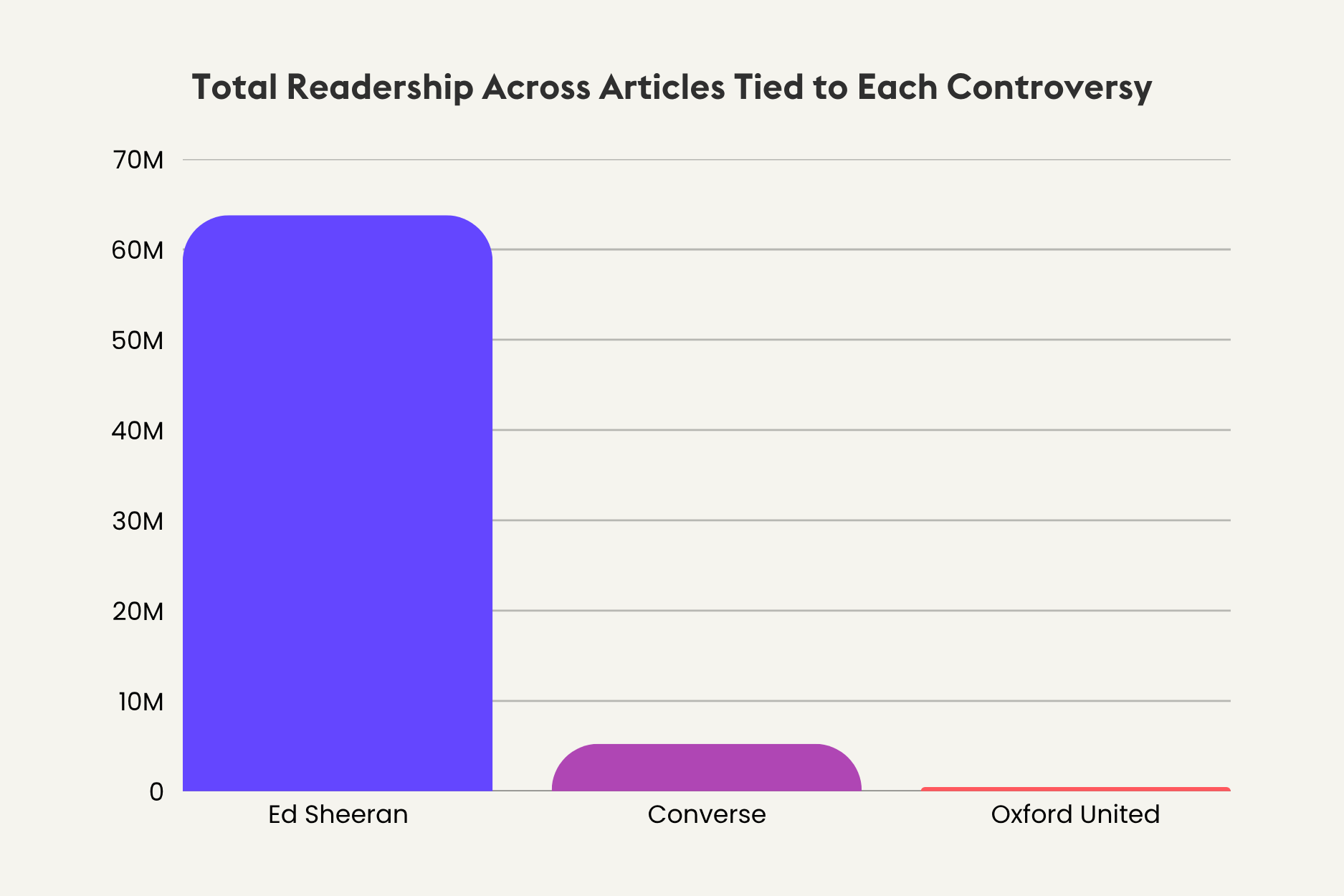
Converse’s ad controversy generated nearly 5.25M in total readership, with attention concentrating quickly. 3.37M in readership came on September 19 alone, representing 64% of the total.
But the bigger story was how directly the controversy became attached to Converse itself. Articles that put the brand in the headline accounted for a disproportionately large share of readership, showing how quickly attention shifted from the creative to the company behind it.
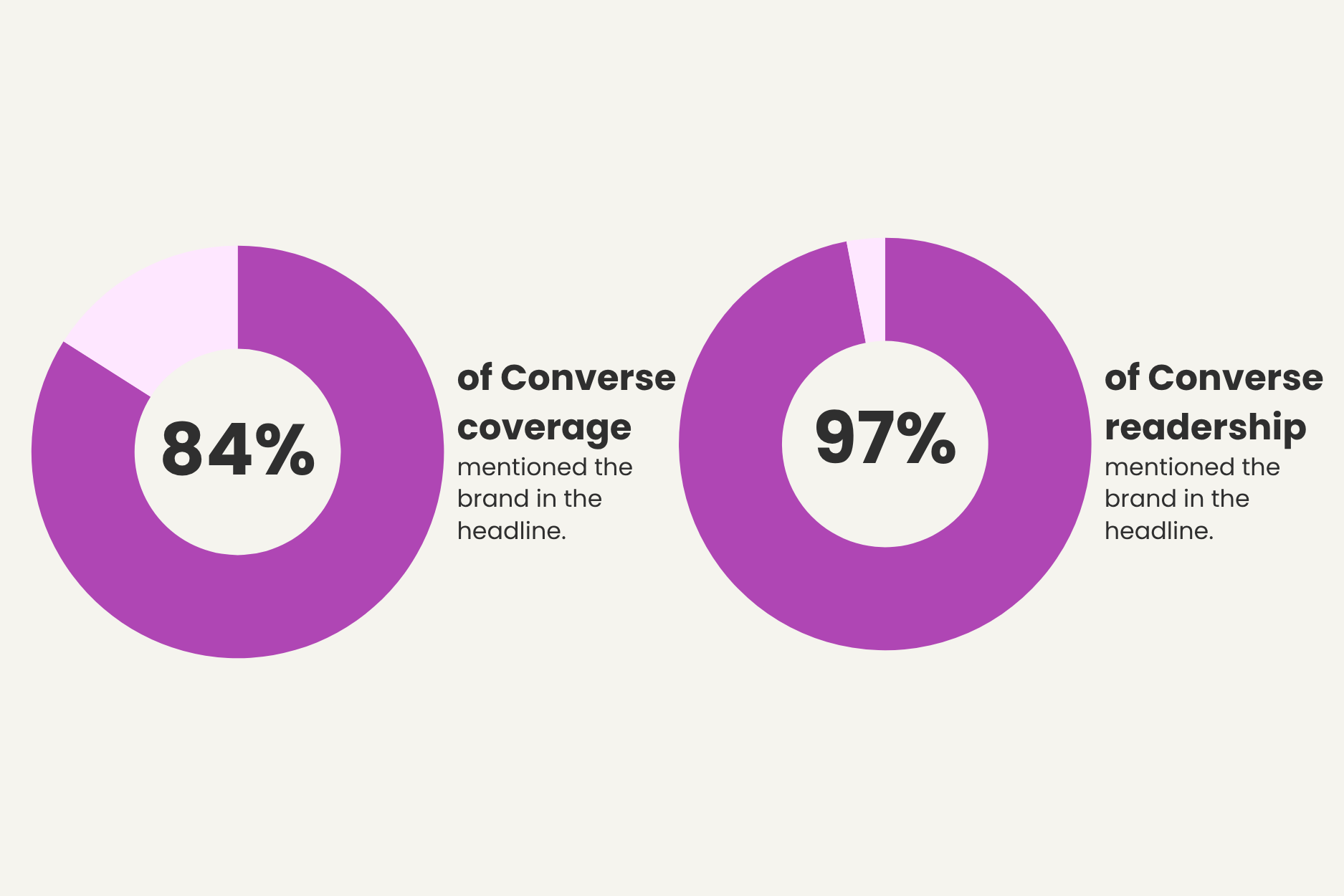
The lesson goes beyond “review your creative.” Creative review is reputation management. Once an unintended interpretation takes hold, the conversation can quickly shift from what’s wrong with the ad? to what’s wrong with the brand?
The question for comms: What could audiences see that we don’t?
2. Oxford United shows that context can turn something innocuous into a crisis
Oxford United's controversy was much smaller, generating roughly 463K in total readership.
But the controversy itself was sparked by something deceptively simple. The club's “United 93” collection referenced its 1993-94 season. In isolation, the name made sense. Around the 25th anniversary of September 11, it carried an entirely different association.
The BBC's story about the club apologizing for the “United 93” shirt generated 172K in readership, making it the most-read Oxford United article in the dataset by a wide margin.
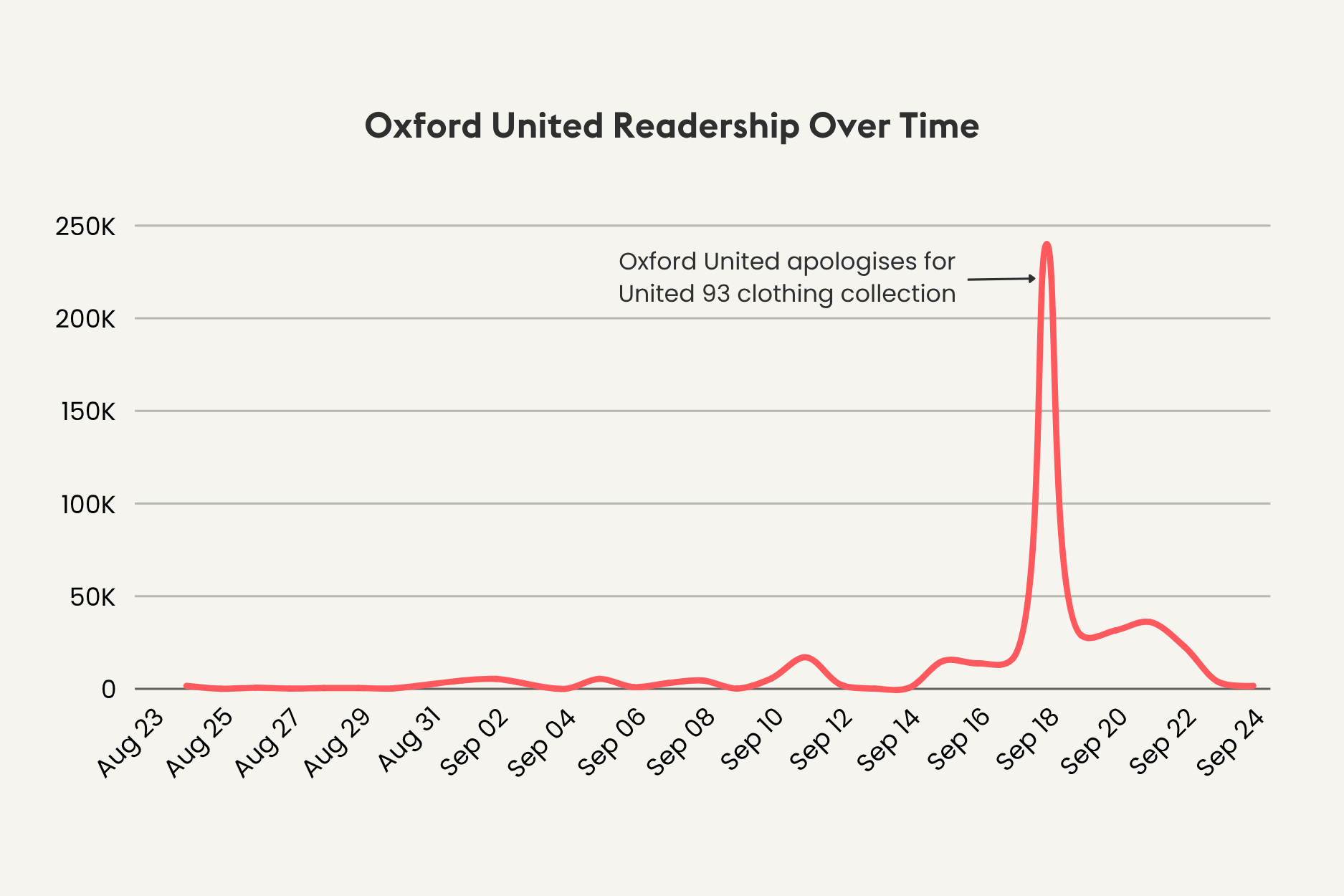
That's what makes this case so instructive. The risk wasn't necessarily the product or the name. It was the context surrounding their release.
Campaigns don't enter a vacuum. Cultural moments, anniversaries and current events can completely change how otherwise innocuous language, imagery or products are received.
The question for comms: What else could this mean right now?
3. Ed Sheeran shows that control and reputational exposure aren't the same thing
The controversy surrounding Ed Sheeran's tour dwarfed the other two, generating almost 64M in total readership.
But Sheeran said he hadn't made the decision to remove Macklemore. The promoter said venues had indicated they would not host upcoming shows with Macklemore still on the lineup, and Sheeran said the promoter's decision was final.
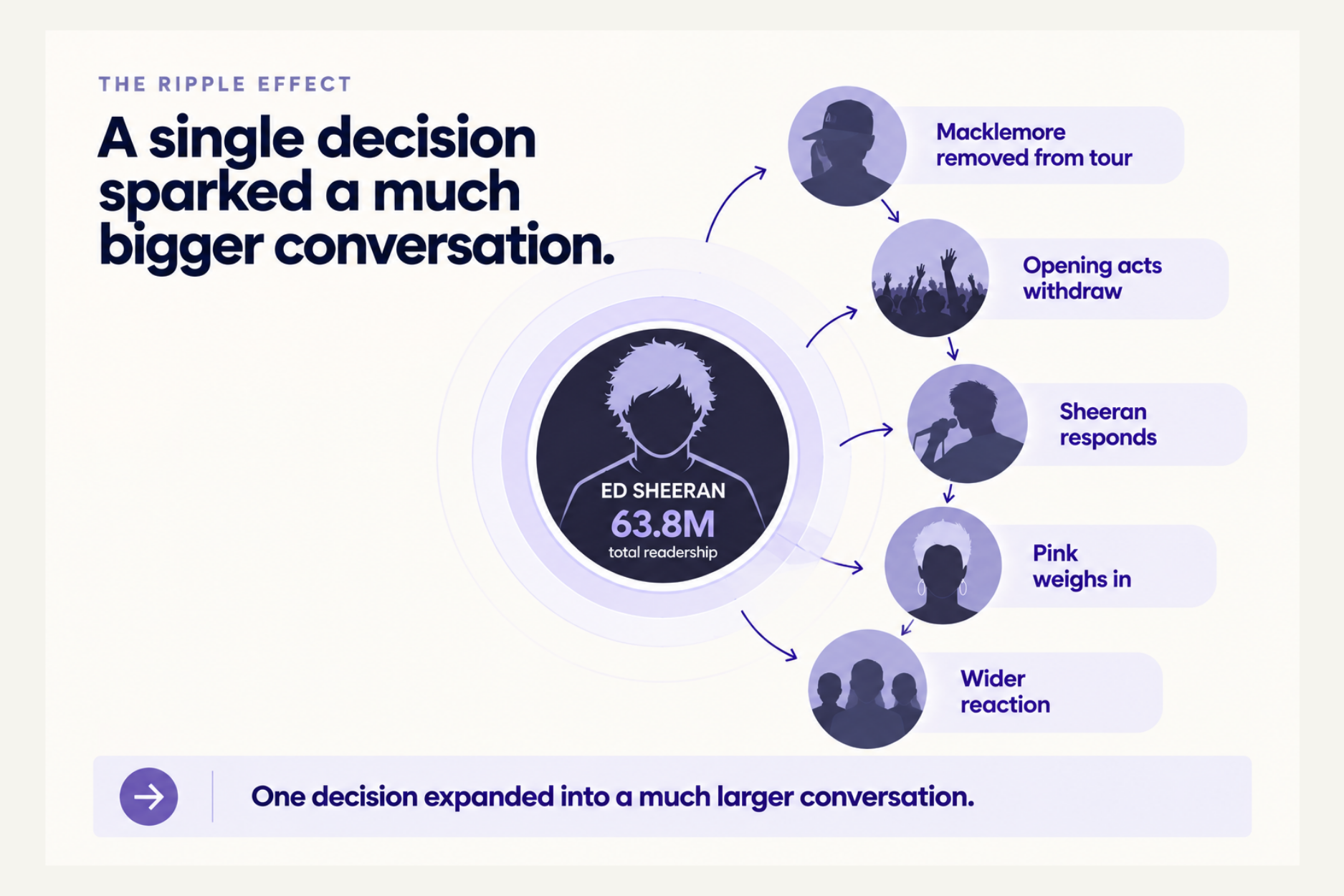
That's the bigger communications challenge: the person making a decision and the person absorbing its reputational consequences aren't always the same.
A promoter, agency or partner may have operational control, but the most recognizable name can still become the face of the fallout.
The question for comms: Whose reputation will absorb the decision if it goes wrong?
Final thoughts
Converse illustrates creative risk. Oxford United illustrates context risk. Ed Sheeran illustrates control risk.
Each started somewhere different. Every one eventually became a communications problem.
That's why the next evolution of communications may be less about crisis response and more about reputational QA: identifying how a decision could be interpreted before the public does it for you.
Before something goes live, communications teams should pressure-test three things:
- Creative: What could audiences see that we don't?
- Context: What else could this mean right now?
- Control: Who will own the reputational consequences, regardless of who actually made the decision?
The goal isn't to build a faster apology machine. It's to catch the story while there's still time to change it.
Because your next PR crisis may not begin with something your communications team said or did.
It may begin with a decision they never got the chance to review.
Until next time,
Nikki at Signal AI
Resource round-up:
- Converse pulls 'deeply upsetting' advert after backlash (BBC)
- English soccer club sorry for launching ‘United 93’ clothing collection around 9/11 anniversary (CNN)
- Ed Sheeran Breaks Silence on Israel-Gaza at First Show Amid Tour Controversy: ‘I Cannot Hide How I Feel About It Anymore’ (Yahoo!)
Methodology:
Analysis of 8,040 articles published August 23–September 24, 2026, covering the Converse Chuck 70 X campaign, Oxford United “United 93” collection and Ed Sheeran Loop Tour/Macklemore controversy. Memo readership measures unique visitors at the individual article level using data sourced directly from publishers. Total readership represents the sum of article-level readership and is not deduplicated across articles.