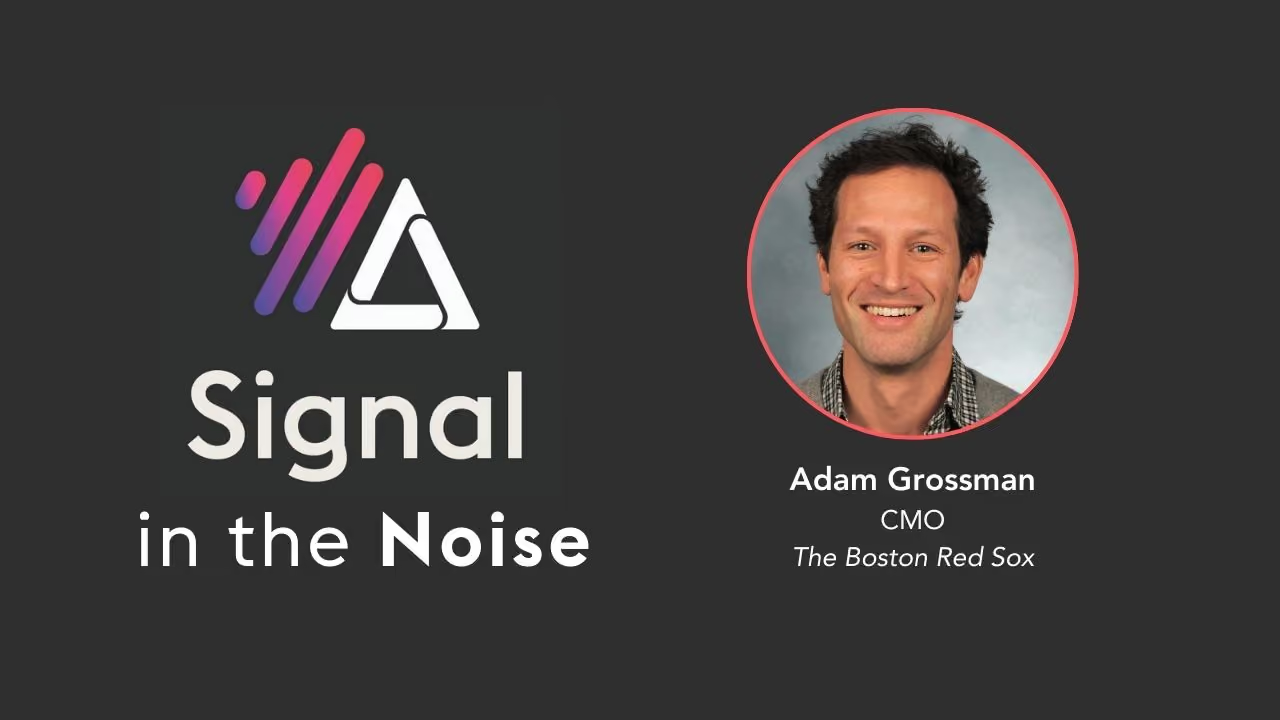
This episode features Adam Grossman, Chief Marketing Officer of the Boston Red Sox. The discussion covers how a baseball team could exist as both a private business and a public institution, including the responsibility to fans, why Adam focuses on marketing to people on their terms, and the challenge of blending history and tradition with big, bold marketing swings.
Signal in the Noise is hosted by Daniel Gaynor, Head of Strategic Solutions at Signal AI.
Below is just a snippet of the conversation. For more episodes, check out the Spotify channel to listen or the YouTube channel. This transcript has been edited for length and clarity.
“We're really proud of the history and the success, but we also know we need to evolve. We need to be bold. What people want today is not what they wanted 20 years ago.” - Adam Grossman.
Daniel Gaynor: Adam, you joined the Boston Red Sox in 2002. The Red Sox, at that exact moment, are quote-unquote “the most cursed team in sports” — that part of Boston is a nuclear wasteland, and this team needs a massive turnaround. I know you were a relatively junior guy at that time, but can you just reflect on what the vibe felt like? Because you weren't always part of this incredible success story.
Adam Grossman: Yeah, there are a couple of pieces to dissect there. I got this internship, and on my first day, I was going to be part of baseball operations. I met this guy whose name was Theo Epstein. He made fun of the shoes that I was wearing. On the first day, I was like, ‘Oh, okay, this will be interesting.’
It felt like this startup that happened to have a 90-year-old history and a big brand associated with it. But you could tell Theo was brilliant, motivated, hungry, and just had an extra gene with him. I felt like I was part of this team that was building this spaceship that was trying to take off and reimagine what was possible. To be very clear, my role in that spaceship was getting people lunch and, at that point, labeling tapes. I was not an engineer by any means.
I was there for three months. I worked for Larry Lucchino, and he needed somebody to be a bit of a right-hand. When I got to Larry's office, I understood what he was doing. It was interesting, as in the world of baseball operations, it was very much looking at baseball as a science. Larry, at that point, was overseeing all aspects of the organization but really looked at the Red Sox as a public institution that was a private business.
“The way [Larry Lucchino] managed and led was that you shouldn't have to choose between winning, baseball, business, community, or renovating a ballpark. It could all happen.” - Adam Grossman.
The way he managed and led was that you shouldn't have to choose between winning, between baseball, between business, between community, between renovating a ballpark. It could all happen. You don't really have to choose between these things. When I started working for Larry, my eyes really started to get bigger.
The talent accrual that both Larry and Theo valued was a movement and transition of being bold - being ambitious. And just breaking down walls, and that could be around goals on field business goals. It could be about letting people on the field where it was this hallowed ballpark.
Charles Steinberg, the head of public affairs, had this idea of doing a Father's Day catch 800 people on the field at one point. That never happened.
Being able to see and experience that, knowing Boston was a pretty parochial place and the history of Fenway, there were sort of lines of demarcation. Larry was just one of those guys who loved busting up tradition and rules, even though there was a real embrace of how important history and tradition are to brands and to where the organizations were at that point.
So that gave you a little history on, you know, in sort of a sense of what it was like, especially for a kid, 22 years old, fresh out of college. It had a little bit of an almost famous dynamic to it where you're just sort of like, wow, like this is pretty special, and it's incredible to be along for the ride as long as I can hold on and they don't throw me off the train.
"Nobody needs to come to Fenway Park to live... We need to make sure we're providing an atmosphere that people are circling their calendars to come." - Adam Grossman.
DG: You said a line that I think is the ultimate narrative for your story there: a private business, but very much a public institution. I mean, this is Fenway Park. The Red Sox in the city of Boston in the region of New England are a downright religion, let alone a fun day at the ballpark. How have you carried that ethos forward now to being chief marketing officer?
AG: Yeah, I think the principles from day one haven't changed. They truly haven’t. Again, I think the boldness, as John Henry talks about, has embodied it since the day he came here. And I think that has transferred to so many, including Larry, Theo, Sam, and everyone. You have to be bold. This is also why we work here, and we have a tremendous amount of pride in being part of the Red Sox and Fenway sports.
We always talk about this as it relates to The Red Sox — nobody needs to come to Fenway Park to live. People will go along whether they come to Fenway, whether they watch another game or not - this isn't food and water and shelter. So when you sort of take that and rewind that and say, all right, well, based on that, we need to make sure that people feel welcome here, that people want to come here, that we are providing an atmosphere that people are circling their calendars to come to do that.
It's a true destination. How we communicate, whether it's through marketing channels, whether the experience here through ushers, ticket takers, through the product on the field, teams that represent the community, and that people can get behind. These are all things that we want to make sure that we're working towards because, again, no one needs to come to a baseball game to live.
"How are we marketing? How are we entertaining people on their terms - not on ours?" - Adam Grossman.
DG: Therefore, the bar is much higher. You very much had to reimagine the space to command that kind of enthusiasm because it is an optional experience.
AG: We look at Fenway as a public gathering place, and that baseball is a massive slice of that pie chart, but it's not a hundred percent. When we had their first Springsteen show in ‘03 - that was groundbreaking. This year we're going to end up doing 12 shows. The point of this is that we can get into some of this, even within a baseball game or sort of a baseball experience; what we are trying to do is have Fenway Park be this communal gathering place on other people's terms.
Even if you are not a huge baseball fan, but you want to come to Star Wars night, or Alex Cooper happens to be here and is throwing a party on the right field roof deck, or we're having, for the first time this year, a Brazilian night, or we've had Dominican nights the last several years or Pride night - we're seeing these celebrations, and these themes start to grow, which is sort of this component of: How are we marketing? How are we entertaining people again on their terms, not on ours, but on theirs?
We're really proud of the history. We're really proud of the success, but we also know that we need to evolve. We need to be bold. And we think that hunger has allowed us to kind of be on what we try to feel like, which is at the forefront of making sure that people feel comfortable and want to come here to be entertained and be with others. What people want today, 20 years ago, but the principle of how we operate, how we approach, and sort of mindset hasn't changed in two decades. ----
Signal in the Noise is a podcast dedicated to helping today's business leaders navigate the complexities of decision-making by leveraging data and groundbreaking technology—first and foremost, artificial intelligence (AI). You can also watch the interview on our Signal AI YouTube channel here.