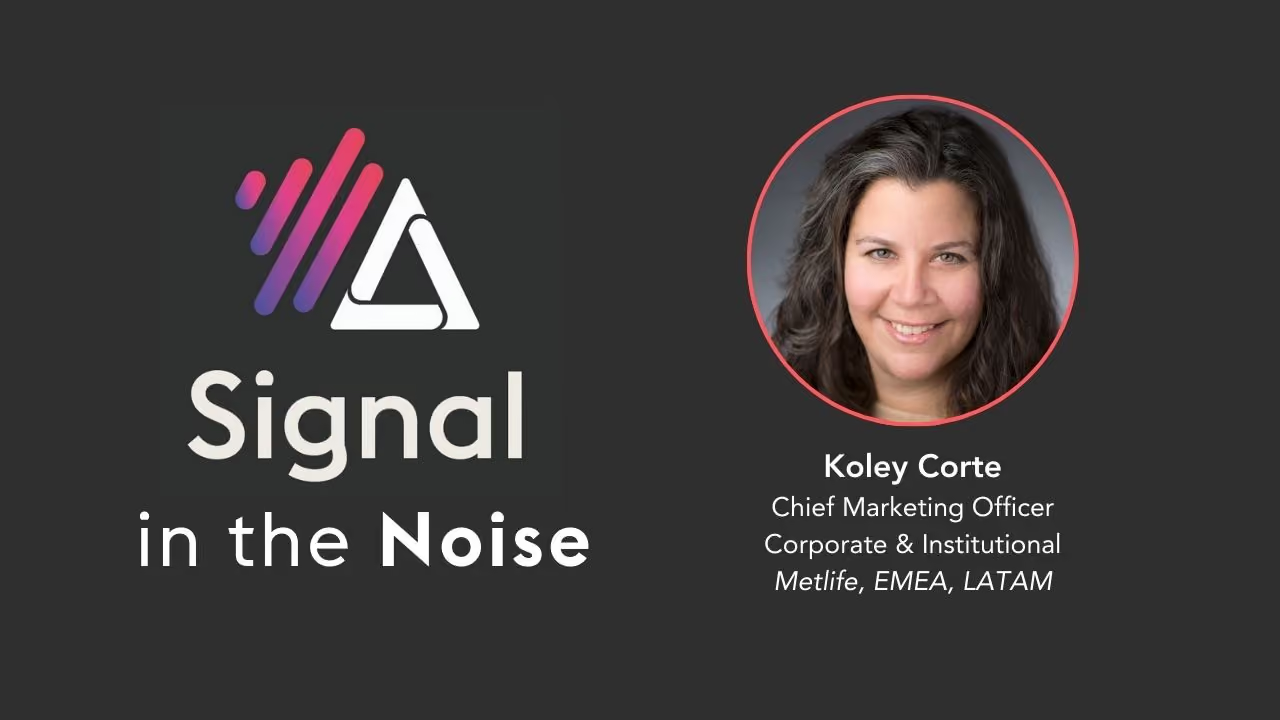
Today's episode features an inspiring conversation with Koley Corte, Chief Marketing Officer, Corporate & Institutional at Metlife, EMEA, LATAM.
Koley shares her impressive journey to the top of a Fortune 100 company, highlighting her relentless pursuit of knowledge and passion for innovation. We explore her insights on AI's impact on marketing, the importance of healthy team friction, and her commitment to being "the girl of the people." Signal in the Noise is hosted by Daniel Gaynor, Head of Strategic Solutions at Signal AI.
Below is just a snippet of the conversation. For more episodes, check out the Spotify channel to listen or the YouTube channel. This transcript has been edited for length and clarity.
"What I think is super important is that we get to know all our customers... How do we harness that knowledge, data, and insight to drive more personal and relevant engagement at scale?" - Koley Corte
Dan Gaynor: Koley, you work at an incredible scale. Metlife is a Fortune 50 company, and you're the Chief Marketing Officer for corporate and institutional. Tell us what that means.
Koley Corte: I'm the CMO for our regional businesses in EMEA and LATAM, our institutional businesses, which are our retirement income solutions businesses, and our investment management business, as well as the global head of customer insights and analytics.
What I think is super important is that we get to know all our customers. We don't know them all at a corporate level, but somewhere in the business, everyone knows one of those customers.
How do we harness that knowledge, data, and insight to drive more personal and relevant engagement at scale? To your point, we need to be able to do it at scale. How do we use new tools and new solutions? How do we use that knowledge as the place that we start to create all of the ways that we can develop solutions, we can engage those customers, build and grow new relationships, and expand the relationships we have?
"The idea is that everything we're doing is close to that customer. It's not sort of a ubiquitous customer 'up here.' It's an actual customer in the market." - Koley Corte.
DG: Can you talk about what that transformation looks like? How are you driving that across the organization? What's changed over the past year or two when it comes to data? I'd be very interested in how you try to bubble up and coalesce knowledge from across a vast global organization into a focused marketing approach.
KC: I would say there's less of a consistent, focused marketing approach across everything. It's much more tailored to our products, which are different in the markets. Our customers are different in the markets. The regulatory environment is different in the market. I think there are some core theses we're working on refreshing our enterprise brand strategy.
You'll get core elements that will work across the markets, but how we create value is really at the market level. Understanding those customers and how you create solutions for them off of that sort of global chassis allows you to customize things from an analytics and insights perspective.
One of the things we use globally is the net promoter score as a barometer of the ability to advance customer loyalty. We have a customer commitment to loyalty as part of our publicly published next-horizon strategy. Our NPS is our metric for driving that loyalty. We are using similar measurements, and then we're taking that to drive insights that drive actions at customer council levels to drive results that are very close to the customer. The idea is that everything we're doing is close to that customer. It's not sort of a ubiquitous customer up here. It's an actual customer in the market.
"We're using tools that enable us to personalize content and create a journey. That'll get richer as we learn from those experiences, as we build more data." - Koley Corte.
DG: Like you said, marketing, at the end of the day, is connecting with people. I'd be interested in how you're using data and or AI to drive more powerful and targeted stories at the customer level.
KC: My goal would be that we could personalize every outreach. How do we use data to help us understand where you are, what's important to you, and what's relevant to you, either as a segment or as a person, hopefully down the road? Then, how do we use AI to help us path you to that content so we can do it at scale?
Today, we use segments because it's the closest way you can get to personalization. In the future - and we're doing some of this now - we're using tools that enable us to personalize content and create a journey. That'll get richer as we learn from those experiences, as we build more data and as we connect that data better.
...
At Signal AI, you're able to view the sentiment at scale in real-time. I think it's super interesting to see what's possible, and I think it'll just get better. Every innovation that we've ever been through has just made us better. It's fun to play, and it's fun to learn.
"Data changed sports. Why wouldn't it change how we do business?" - Koley Corte
DG: Something you said earlier, I think is very resonant in the B2B space, which is they're filled with human beings who have emotions and impulses like everyone else. One of the things I really admire about you is your posting on LinkedIn. Why do you think it's important for folks in your title to step forward and do thought leadership on your own?
KC: Earlier in my career, I had someone give me advice that your brand becomes important to you externally. As you build your career, you build some external expertise. I'm perceived as an expert in the industry. That also helps internally, to help people be motivated, see a role model, want to listen to me or hear what I have to say.
I feel like I have a couple of pillars I talk about externally. Or when I join things like this podcast and when I post on LinkedIn. They are part of who I am. They're authentic. But they're also part of how I want to talk to people. And it is about the future of marketing; it's about leadership. Then there are some things that are more about either A, MetLife, or B, about me. Because it's authentic to who I am.
The things about me tend to cross over those different pillars. I try to bring in a lot of stories about my dad because he has a lot of good stories. He's a big influence on me. And he's a lot of how I learned about sports.
If we think about sports data, it transformed sports significantly. If you look at how in the NBA people take shots versus how they used to take shots - data has really informed that. Now talent has also informed that - players like Steph Curry.
It's the same when you look at baseball. My dad would always say to me: 'In my day, that pitcher pitched the whole game.' And I said: 'Yeah, the data shows that they shouldn't pitch the whole game. So now you can have a closer.' When I told him that, that's how he understands what I do.
Data changed sports. Why wouldn't data change how we do business? Why wouldn't data inform every decision we make? Because we can make better decisions. Now we have more insight. We have more history of data.
Those are the things that help us connect. They build authentic connections so that then we can have that debate.
---
Signal in the Noise is a podcast dedicated to helping today's business leaders navigate the complexities of decision-making by leveraging data and groundbreaking technology—first and foremost, artificial intelligence (AI). You can also watch the interview on our Signal AI YouTube channel here.