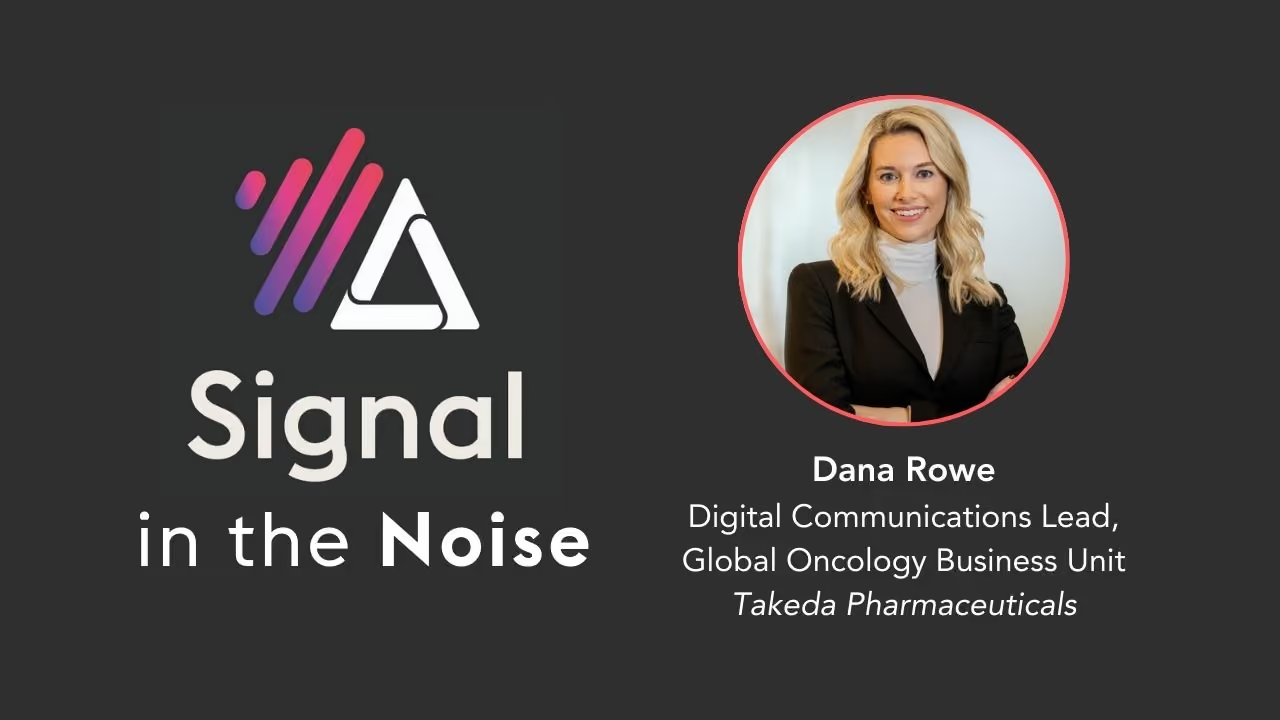
In today's episode, we speak with Dana Rowe, Digital Communications Lead of the Global Oncology Business Unit at Takeda Pharmaceuticals, one of the world's largest pharma and biotech companies.
She shares with us the evolution of her marketing and communications career arc into the healthcare sector, how Takeda embraces digital transformation for a communication strategy to stand out in the sea of sameness, and how she's focusing on data-driven measurement and external intelligence powered by AI to be more agile and proactive in corporate storytelling. Signal in the Noise is hosted by Daniel Gaynor, Head of Strategic Solutions at Signal AI.
Below is just a snippet of the conversation. For more episodes, check out the Spotify channel to listen, or the YouTube channel to watch. This transcript has been edited for length and clarity.
"Communications in oncology and other business units are often milestone-driven, but it's important to stay relevant even without natural news drivers." - Dana Rowe
Dan Gaynor: I've been impressed with your data-driven, digital-first approach to storytelling in the Oncology space. I'd love to hear about that journey. When you walked in the door and now look back, what did that transformation feel like? What are the key forks in the road? What are the accomplishments you're proudest of?
Dana Rowe: When I first started, we were still building out our team structure and adding capabilities. We had a new leader and aimed to up-level our digital capabilities. Initially, it was about social media posts and website edits. We've evolved to nail the basics, maintain and relaunch the website, and have a steady drumbeat of social media content. Now, we have a communication strategy, and storytelling thought leadership pillars, and we augment that with external intelligence to stay relevant. Communications in oncology and other business units are often milestone-driven, but it's important to stay relevant even without natural news drivers. We've focused on building that capability to stay relevant and build awareness consistently.
"Within our oncology communications team, we fully embrace data and digital to guide us from end-to-end strategy to execution and optimization." - Dana Rowe
DG: The key takeaway from what you said is there's a sea of sameness in the healthcare industry. Every company claims to put patients first and embrace health equity. These are real, values-driven commitments. So how can we best convey our proof points on that contested storyline in a way that breaks through? For your editorial calendar, how has data made it easier to align on shared priorities? What does it look like when you bring data into the strategy setting within the Oncology Business Unit and across Takeda as an entire comms organization?
DR: One of the things I love and appreciate about Takeda is our data-driven culture. We are over 240 years old, and we had our anniversary last week, which is exciting. We all recognize that the world around us is changing rapidly, particularly in science and technology.
There's a sense of responsibility to create a future-ready organization and a desire within leadership to expand capabilities for a more digitally fluent workforce. Within communications, there's a passion for embracing data and digital, regardless of your role on the team. Whether you're in internal or external communications, we embrace it to enable our teams to work smarter, faster, and more efficiently, ultimately helping us achieve the goal of creating more impact for our patients. Within our oncology communications team, we fully embrace data and digital to guide us from end-to-end strategy to execution and optimization. The culture within our function and within Takeda communications as a whole shows a shared enthusiasm for adopting this approach to create the most impact possible.
"The insights are great. The data is great. The messaging might be spot on. But if the delivery is not great, then it kind of falls flat." - Dana Rowe.
DG: I want to ask about the comms function of the future. It's exciting that you've embraced data and digital, building it into a team-wide orchestrated offense. For someone listening, whether or not they work in healthcare, what steps could they take to build a more data-driven communications organization that embraces measurement? To drive more thought-provoking activations, breakthrough messaging, and effective content?
Dana Rowe: First and foremost, just from a very simple standpoint, one of the questions that we always like to start with and ask ourselves is, what are we trying to solve? Like, what is the challenge and what are we trying to measure? From there, you can start putting the pieces together.
I'm very fortunate to be part of a team that represents so many different subject matter experts. We have people who really know the PR and Media industry well and folks who are experts in thought leadership, the pipeline, and our inline and portfolio brands.
We also are very fortunate to have our in-house content creation capabilities on our team. And then, you know, a digital practitioner like myself. It really is the combination of all of those skillset to be able to make a program successful because the insights are great. The data is great. The messaging might be spot on, but if the delivery is not great, then it kind of falls flat. So, it truly is a team spirit and team effort. And I think that's honestly one of my biggest takeaways.
---
Signal in the Noise is a podcast dedicated to helping today's business leaders navigate the complexities of decision-making by leveraging data and groundbreaking technology—first and foremost, artificial intelligence (AI). You can also watch the interview on our Signal AI YouTube channel here.