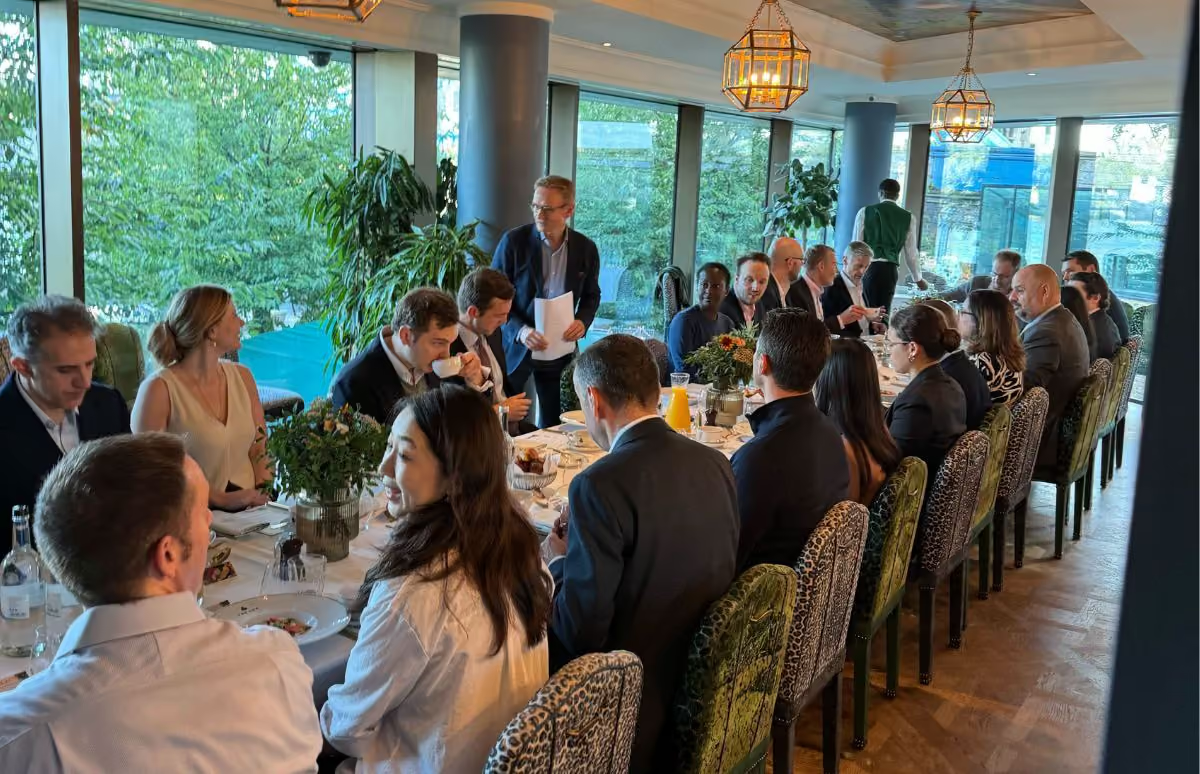
Our recent Exec Connect breakfast in London featured today’s leading reputation and risk management professionals. They discussed the increasing pressure and concern around geopolitical risks, how they impact enterprise business, and best practices for more strategic enterprise risk management (ERM).
Signal AI hosted the event with our featured guest Sam Gyimah. Sam is the founder of SG& Capital Partners, an advisory and investment firm focused on catalyzing the growth of companies at the nexus of the private and public sectors. Sam is also an adviser to and serves on the board of Goldman Sachs International and is a member of the Audit and Nominations Committee. He also hosts the Geopolitics of Business podcast, where he interviews CEOs, investors, and political leaders to explore what happens when business and politics collide and how leaders respond.
Key topics of conversation
- Geopolitical risks are a top concern, particularly for enterprise businesses. How do global enterprises mitigate and overcome those risks?
- The global operating environment is experiencing ‘shape-shifting.’ Geopolitical risks are pervasive and ever-evolving and can have a longer-lasting impact on business than topics like ESG.
- There’s a growing need for more collaboration and alignment with reputation and communications leaders. How should you best manage risk at a corporate level, and what role does the communications leader play? What data, organization, processes, and intelligence are required to enable the resilient enterprise?
Geopolitical risk and the global impact on business
According to Oxford Economics, 36% of companies identified geopolitical tensions as a primary risk factor, surpassing financial risks like credit supply constraints. Over 60% anticipate this risk to be significant in the next five years.
This being the year of Elections, the elephant (and donkey) in the room was the U.S. primaries. This year’s elections don’t just affect democracies, but the world. One topic of discussion was where politics and business were previously mixed. It was agreed that politics was previously separated from business, as Sam analogized, “stuck to their tram lines.” It was only when Politics “set the guardrails” that businesses then worked within those lines, causing business and politics to mix. But now, there’s been a systemic change.
What seemed unthinkable 15 years ago is now today’s reality; geopolitics and business are inextricably linked. Like a snowball effect, political risks affect economic risks, which affect business risks, raising questions such as: if Trump were to win the election, how would that impact energy prices? How would that affect US relations with China? What about Trump’s bold promises for tariffs?
Enduring ‘shape-shifting’ in the global operating environment
According to the World Economic Forum, 83% of respondents see geopolitical tensions as the main risk to global economic growth in the coming year. For business leaders and enterprise organizations, this new complexity within the global operating environment—which Sam called “shape-shifting”—is extremely hard to manage. CEOs and executive leaders are not trained in geopolitics and struggle to fully grasp the impact of geopolitics on business.
“Politicians don't understand business, but business leaders understand politics less.” - Sam Gyimah
Geopolitical risks are pervasive and ever-evolving. They can have a longer-lasting impact on business compared to topics like ESG. This shape-shifting is expressed in many areas of business operations, for example, DE&I policies that are right for one market but not right for another operating market or products, such as educational material, that need to adjust and tailor content according to policies across U.S. states.
The Risk and compliance landscape continues to rapidly diversify, driven by increased attention to non-financial risks. Geopolitical events can have a ripple effect on customer demand, supply chains, tariffs, people and talent, investor and stakeholder decisions, and more. It’s also difficult to manage prioritization and framing without a quantifiable impact.
Three major ‘shape-shifts’ need prioritization:
- The long-term tensions between the U.S. & China
- De-globalization and what that does to supply chains, product-market fit, regional vs. global decision-making
- The rise of new technologies that are changing these markets and become policies
With the increased velocity of risks changing, how can business leaders keep up and more proactively prepare for what’s to come? One best practice discussed was to prepare before a geopolitical issue becomes something larger by actively monitoring not only the biggest political tension but also the ones to come. Understand the patterns of these geopolitical trends; while some are long-term, others come in waves. For better horizon scanning of emerging threats, perhaps the best place to start is across the hall.
Aligning enterprise risk management (ERM) and reputation management
For anyone in a global company, wherever you turn it’s difficult to have a coherent global strategy in a world that is splintering. The fragmentation and globalization of markets are not transient, but structural.
Key questions were raised:
- “Who owns Geopolitical risk across a global enterprise?”
- “How often is it reported on to the Board?”
- “Is it best to follow and focus on regional or global strategies?”
- “When advising the CEO/ Board, how do you craft a coherent view?”
Several points were raised that Risk and Communication professionals need to coordinate more closely if these geopolitical challenges are to be identified early and mitigated. The general consensus in the room was that in most organizations, these two functions have a weak working relationship.
Enterprise risks and reputation risks cannot be siloed. There needs to be a more collaborative environment between the two functions and risk owners. Best practices require robust external intelligence, updated data, and coordinated processes, with communications leaders playing a pivotal role in managing corporate risks.
On an optimistic note, if businesses manage to align their reputation and Communications departments with risk management to be more proactive, emerging risks will have a better chance to transform into opportunities.