
FIFA World Cup 2026 sponsors are competing for more than tournament rights; they're competing for media relevance.
Hosted across the United States, Canada and Mexico, the tournament is expected to draw billions of viewers. But while dozens of brands have secured official partnerships, the early media data reveals a much sharper reality: visibility is not being distributed equally.
Our analysis of more than 100,000 media articles covering 24 official FIFA World Cup 2026 sponsors reveals clear winners, emerging risks and an increasingly important truth for marketers: sponsorship alone no longer guarantees relevance.
Which FIFA World Cup 2026 sponsors lead on media coverage?
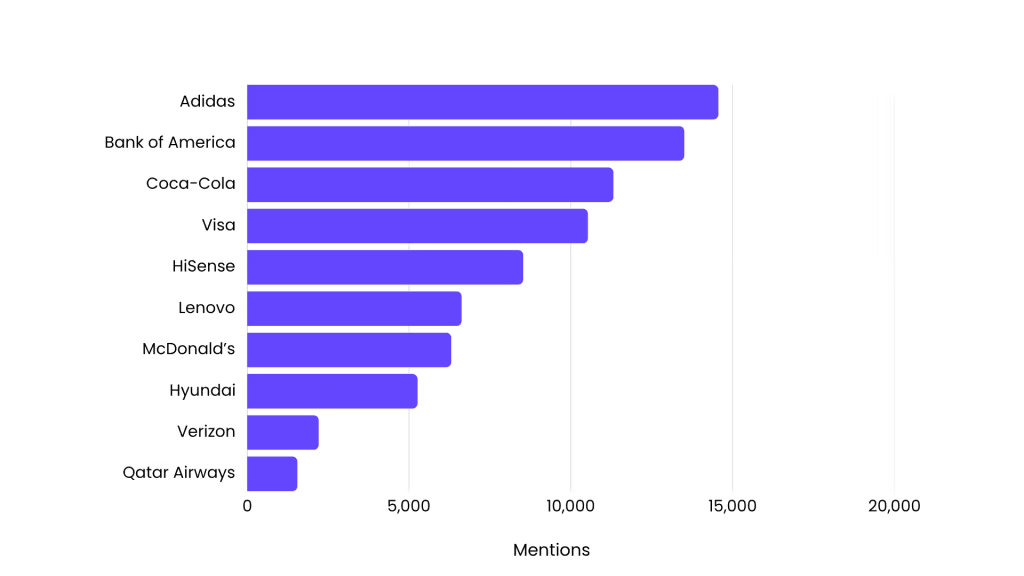
Across all tracked sponsors, a small group of brands accounted for a disproportionate share of the coverage generated in global pre-tournament media coverage.
Adidas and Bank of America lead the field with roughly 14,000 mentions each, making them the two most visible sponsors in the media landscape so far. Coca-cola, Visa and Hisense follow closely behind, each generating more than 8,000 mentions.
Budget size isn't the differentiator. The brands outperforming the field are creating campaigns, product activations, partnerships, and fan experiences that give journalists and audiences something tangible to engage with.
Visibility Alone Does Not Equal Influence
Raw mention volume tells only part of the story. One of the most revealing metrics in our analysis is salience: a measure of how central a brand is within the articles that mention it. A sponsor can appear in thousands of articles simply by being listed among FIFA partners. Brands with high salience are becoming the actual subject of coverage.
Hyundai leads the field here, combining strong overall mention volume with the highest salience score in the dataset. Its digital activations and connected-car initiatives tied to the tournament are generating genuine editorial interest, not just passive association.
The bigger surprise is McDonald's. It ranked ninth on total mentions but jumped to second on salience, meaning the coverage it receives tends to be directly about the brand. Coca-Cola sits third, signalling consistent, focused World Cup storytelling.
Positive Sentiment Dominates, With a Few Important Exceptions
Overall sentiment surrounding FIFA World Cup sponsorship remains overwhelmingly positive.
Nearly 89% of all sponsor-related coverage across the dataset carried a positive tone.
Several brands achieved exceptionally strong sentiment performance:
- AB InBev recorded 93% positive sentiment across its coverage.
- Hisense maintained a remarkable 99.7% positive rating despite massive media volume.
- Marriott Bonvoy, Hyundai and Valvoline also posted positive ratings above 96%.
These brands share one important characteristic: most of their coverage connects directly to tournament activations rather than broader corporate controversies.
Other sponsors are navigating more complicated media environments. Airbnb generated 1,000+ mentions but also recorded one of the highest negative sentiment rates among major tier 3 sponsors. Most of that appears tied to ongoing debates around housing affordability in World Cup host cities.
The Most Effective Sponsors Are Building Stories, Not Campaigns
One pattern emerges clearly across the strongest-performing brands. The companies generating the best combination of visibility, salience, and sentiment are treating the World Cup as a storytelling platform rather than a logo placement.
Hyundai is connecting the tournament to technology and mobility innovation. Coca-Cola is building on decades of football equity while developing culturally resonant fan experiences. These are integrated brand narratives, built for digital media, social amplification, and editorial pickup.
The data shows that modern sponsorship success depends less on official rights and more on a brand’s ability to create moments audiences actually care about.
What Brands Should Learn From the Early Data
Three lessons stand out from the sponsorship landscape so far.
1. Our analysis of FIFA World Cup 2026 sponsors shows salience matters more than raw reach.
Massive visibility means little if a brand remains peripheral to the story. The strongest-performing sponsors are creating campaigns that place them at the center of the conversation rather than the margins.
2. Sponsorship without activation creates noise, not impact
Simply appearing alongside FIFA branding is no longer enough to generate meaningful attention. Brands need culturally relevant campaigns, compelling partnerships and editorially interesting ideas to break through.
3. Reputation management now shapes sponsorship performance
World Cup sponsorships do not exist in isolation from broader public perception. Brands facing housing, economic or corporate controversies carry those narratives into tournament coverage whether they intend to or not.