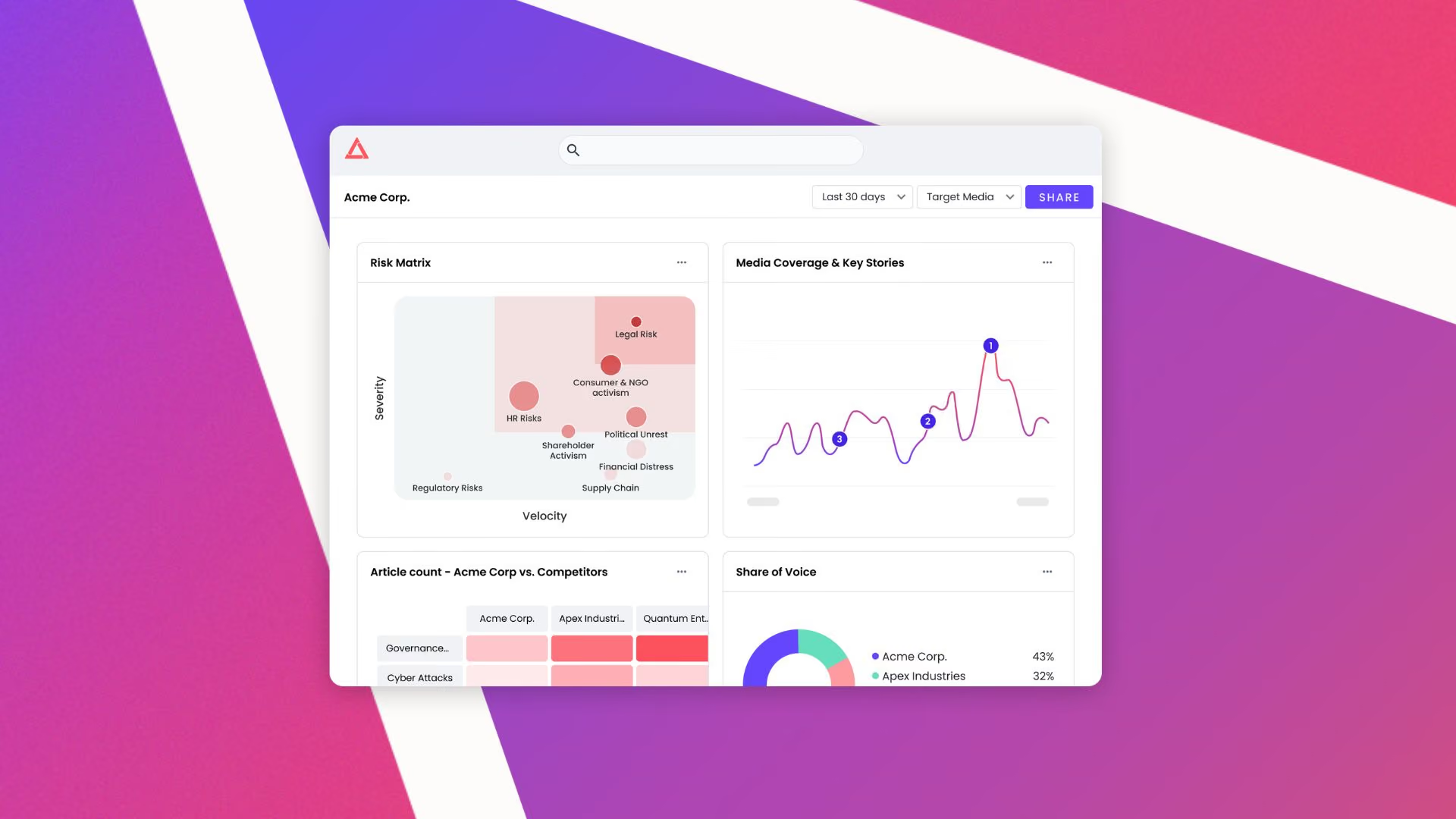
Most teams come to Signal AI with a question. What risks are we missing? How do we prove communications moves the business? Where is the white space our competitors haven't claimed yet? The platform earns its place by turning those questions into answers you can act on, drawing on 5M+ articles and documents processed in near real-time every day, across 226 markets and 120+ languages.
Here are five questions real teams brought to the platform, and exactly what you can do to answer each one.
"How do we catch the risks we don't yet know to look for?"
Risk and audit teams know the frustrating part of a manual search: it only ever confirms what you already suspected. The unknown risks, the developments sitting outside your framework, are the ones a Google search is least likely to surface. And the volume is punishing, made worse by anything published in another language.
On the platform, you build custom Topics for the risk themes that matter to a given audit, then let it monitor them continuously across 120+ languages and 175+ jurisdictions. Key Stories surfaces a ranked shortlist of the most significant developments in each Topic, so your analysts scan the signal instead of thousands of raw articles. One audit team started using Key Stories as a quality check on its own framework: a fast way to see what was surfacing that their topics hadn't anticipated, and flag it to the audit teams.
The result is a faster quality-assurance process, better identification of unknown risks, and consistent coverage across every market you operate in.
"Can we stop checking 20 websites a day and still miss nothing?"
Plenty of expert teams start the day the same way: opening 20+ websites and clicking through in the hope of catching anything important. It's slow, it puts skilled people on low-value work, and missing one development can be expensive.
On the platform, you define the themes and markets you need to track once, and the automated monitoring runs from there. Relevant developments are packaged into Curated Newsletters and sent automatically to the people who need them, internal and external, on a schedule you control. Real-Time Alerts handle anything time-sensitive, so a shift in regulation becomes an early warning rather than a late surprise. The same setup doubles as horizon scanning: one team used it to catch early signals of changing content rules in markets they were about to enter, well before those rules took effect.
For one regulatory team, bulletins now reach 1,000+ internal and 200+ external readers with no manual compilation, and experts get their time back for expert work.
"How do we prove communications moves the business?"
Communications teams know they contribute to reputation. Proving it, in a way the board acts on, is the hard part. Reporting is often manual and siloed, and it's difficult to connect PR activity to the strategic priorities leadership actually cares about.
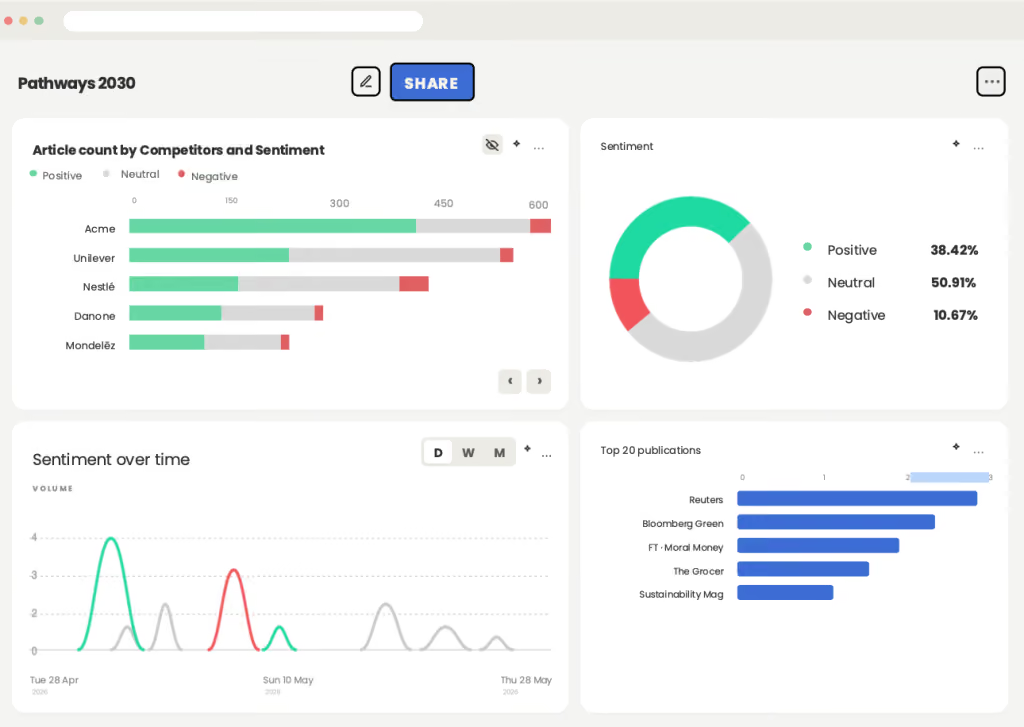
On the platform, you build unlimited Dashboards aligned to specific KPIs and pull an insight for anyone internally in seconds. A consistent quality score tracks sentiment as data over time, Share of Voice (SoV) shows exactly where you own the conversation and where a competitor does, and competitor cohort analysis lets you benchmark reputation against a defined peer set to spot reputational risk early. You can send daily snapshots straight to the CEO through Curated Newsletters, and feed quarterly media impact reports into formal reputation reviews. Where you want a human layer, Signal AI analysts help verify, organise, and enrich large volumes of coverage into reports the board trusts.
That's how communications teams move from cost centre to strategic adviser: board-ready reporting, a shared view of reputation versus competitors, and proof that maps to business goals.
"Where is the white space our competitors haven't claimed?"
To know where to move next, you first need a clear read on where you lead, where rivals are gaining, and which narratives no one owns. Google Alerts won't get you there. It produces noise, ignores foreign-language coverage, and surfaces competitor moves too late to respond.
On the platform, Topic Analysis shows the breadth and depth of coverage across the themes that define your market, so the narrative white space becomes visible. Competitor monitoring tracks a defined rival set in real time, from strategic and financial topics to product moves and patent activity. Automatic translation turns a story breaking in another market into intelligence you can use, and entity tracking lets you follow specific companies, people, and events as their key moments happen.
Teams use this to steer both the immediate call and the long game: what to share with executives today, which experts to position as thought leaders, and which unclaimed narrative to build a campaign around.
"When something breaks in one of 70 countries, do we hear it in time to act?"
For a brand operating across dozens of countries, the difference between a proactive response and a reactive one is often measured in minutes. Manual monitoring can't keep pace with the volume of news and social coverage in that many languages.
On the platform, AI-powered monitoring watches coverage as it breaks across 226 markets and 120+ languages, so a story anywhere in the world is visible the moment it publishes. Real-Time Alerts give teams the head start to manage a situation rather than clean up after it, and the AIQ engine cuts the manual workload by filtering, classifying, and prioritising coverage. The same real-time picture supports the highest-stakes moments: one retailer navigating a cyber breach used it to understand quickly where customer data had surfaced and what the event was doing to reputation and trust.
The payoff is proactive crisis response, less time lost to manual analysis, and sharper competitor monitoring that supports industry leadership.
Start with the decision, not the dashboard
The pattern across all five is the same. A team brought a strategic question, and the platform turned the world's data into an answer they could act on. Custom Topics and Key Stories to find the unknown risk. Dashboards, Share of Voice, and sentiment to prove impact. Topic Analysis to claim the white space. Real-time monitoring and alerts to stay ahead of a crisis.
Signal AI transforms external data from traditional and social media across 226 markets and 120+ languages into intelligence designed to navigate enterprise risk, strengthen reputation, and fuel growth. The only question left is where you point it first.
Bring your own strategic question and see how the platform answers it.