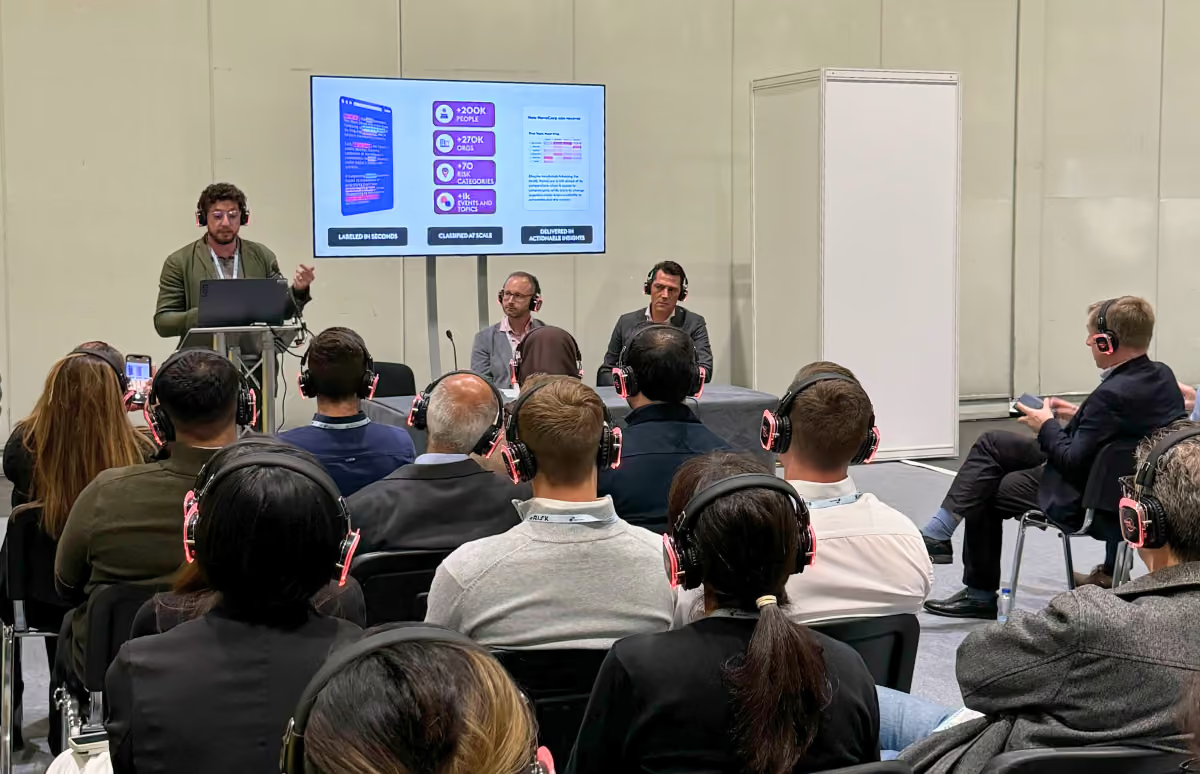
Last week, I had the pleasure of leading a panel at the #RISK London event, along with the Signal AI CEO, David Benigson (recently named 2024 CEO of the year for Risk Intelligence), and Gideon Lamberiks, VP of GRC Product Management at SAI360.
#RISK London is one of the UK’s leading risk-focused expos, bringing together professionals in the Governance, Risk, and Compliance communities to discuss pressing topics in artificial intelligence, security, and reg tech. Even if you couldn’t attend the event, I’ll share my key takeaways from the session here.
We revealed enterprise risk teams have a blind spot—only 10% of the attendees in the room stated they currently use external intelligence tools.

Did you know that 85% of companies with +1B USD revenue have faced a major unexpected operational risk event?* Yet when we asked the audience in the room, we learned that less than 10% were currently using external intelligence tools—such as tools for scanning social media and traditional media—to identify, prioritize, and track risks.
In today’s business operating environment, risks are interconnected and rapid-fire. Take Boeing's 737 Max crisis. A faulty sensor triggered a chain reaction: software malfunctions, tragic accidents, grounding of the fleet, reputational damage, financial losses, and regulatory scrutiny. This wasn't just an engineering problem but a cascade of interconnected risks. More proactive ERM programs need a better solution than ad hoc Google searches or word-of-mouth information sharing.
We shared practical examples of companies adopting external intelligence to mitigate significant impacts.
David Benigson mentioned a couple of pertinent examples of how Signal AI has helped risk professionals use external intelligence in their ERM decision-making process.
One that stood out was an FMCG company whose consumers voiced concerns about one of its ingredients on social media. This concern spread to mainstream media, and eventually, the regulators began investigations. The FMCG company identified this early on, allowing them to rapidly respond to this risk with an appropriate scenario response. Preparing for this potential crisis and taking rapid action to mitigate the threat avoided significant reputational and financial impact.
AI-powered horizon scanning can identify and track both external emerging risks and new business opportunities.
A powerful use case for external intelligence and horizon scanning could be corporations entering a new vertical, amid a merger or acquisition, or looking to offer new products and services. Rather than being used only to scan for threats, the external intelligence toolset can help unlock business opportunities or new areas of interest.
Gideon Lamberiks explained which capabilities of AI-powered external intelligence excite him most:
- Horizon scanning: The ability for real-time insights and trends from billions of global data points
- Competitive and industry landscape: The power to compare companies across industries and provide competitor views so companies can understand if a particular risk event is an outlier or if risks are systematic and contagious
- Quantifying alternative analytics to assess likelihood and impact and feed into company reporting and decision-making processes
Looking ahead, the future of external intelligence will be transformational for risk professionals—if implemented well.
We finished the conversation, star gazing into a vision for the future. Gideon predicted that in three years, external intelligence would be a core component of GRC platforms and integral to how a risk professional assesses risks.
David shared a vision for predictive analytics. In a world that is more volatile and unpredictable than ever, and with technology continuing to advance at an unprecedented pace - AI will present an opportunity to find predictive signals in unstructured data.
Both sound like compelling visions for the future, but how can we turn this vision into reality? Transforming today’s manual ERM processes is no small task. Integrating AI-powered external intelligence into their current GRC process will require a smooth transition and dedicated ERM champions to adopt and implement new tools.
I can’t wait to see how risk teams embrace the opportunity external intelligence presents.

David Pepper is the VP of Risk Solutions at Signal AI, responsible for growing the application of AI across risk, supply chain, regulatory, and ESG applications. You can find him on LinkedIn here.
*BEASLEY, M. and BRANSON, B. (2024). THE STATE OF RISK OVERSIGHT: AN OVERVIEW OF ENTERPRISE RISK MANAGEMENT PRACTICES. 15th ed. ASSOCIATION OF CERTIFIED PROFESSIONAL ACCOUNTANTS.