Welcome to Signal in the Noise, where we show you the real-world impact behind trending news.
Uniqlo suspended store operations across Europe. The Eiffel Tower and Louvre closed early. Disneyland Paris shut down outdoor attractions. Eurostar cancelled services between London and Paris.
On Signal AI's platform, we tracked the narrative connecting heat events to supply chain failures across 4,500+ articles with 24B reach during the peak (June 22–25, 2026).
The headlines faded by early July, but secondary supply chain effects were still spreading. Companies weren't seeing recovery; they were seeing emerging strain surface in new suppliers, new logistics partners, and new dependencies cascading outward.
The question we're asking: When environmental events disrupt supply chains, where does the strain actually spread, and how can you identify exposure before the next one?
1. The peak tells you when operational strain hits the surface, but horizon risk is the real signal
Signal AI tracked how heat events triggered operational failures across European supply chains. Volume peaked at 4,500+ articles on June 22–25, the exact window when France, Belgium, and other European nations experienced critical heat events.
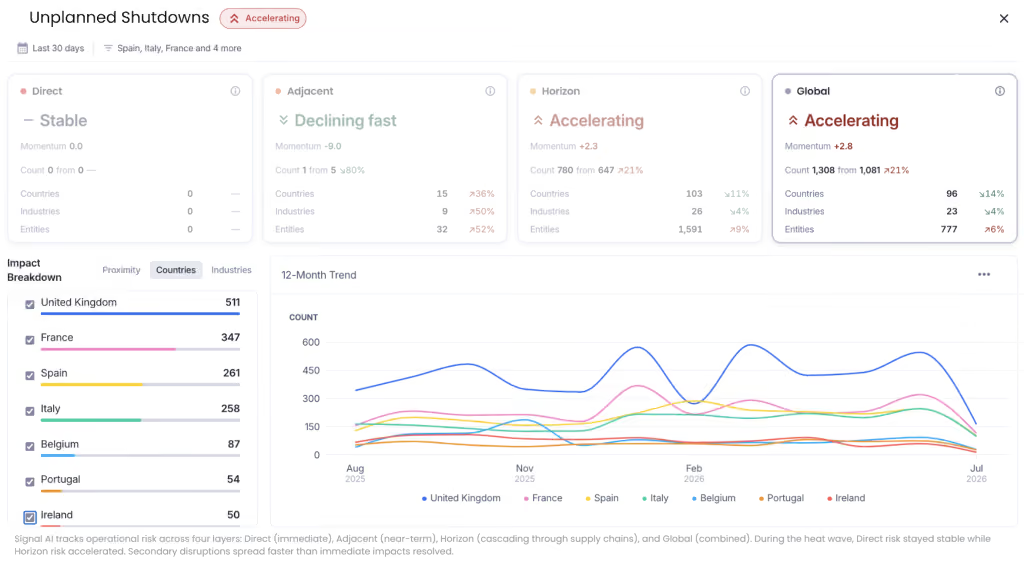
When we analyzed operational risk across energy, logistics, semiconductors, cloud infrastructure, and insurance companies, the Unplanned Shutdown pattern was unmistakable: direct operational risk stayed stable, while secondary effects accelerated outward. The UK saw 511 mentions of unplanned shutdowns, France 347, Spain 261, and Italy 258. Risk in the horizon layer, the one spreading through supply chains, was climbing as news coverage cooled.
Most observers saw the headline spike and assumed it was over. That's the mistake. The real signal isn't headline volume, it's which suppliers and logistics partners are still mentioned weeks later, spreading through new dependencies beneath the fading coverage.
2. Companies caught in the intersection face dual pressure
When heat hits, two things happen at once: immediate facility and workforce disruptions, plus secondary strain cascading through supply chain dependencies. Cold-chain logistics fail, transportation routes go offline, manufacturers scale back, and insurance markets tighten faster than operations recover.
The cost hits immediately, and recovery takes weeks. For companies caught in the middle, that gap becomes margin pressure and valuation risk.
3. Real-time monitoring reveals what's actually cascading
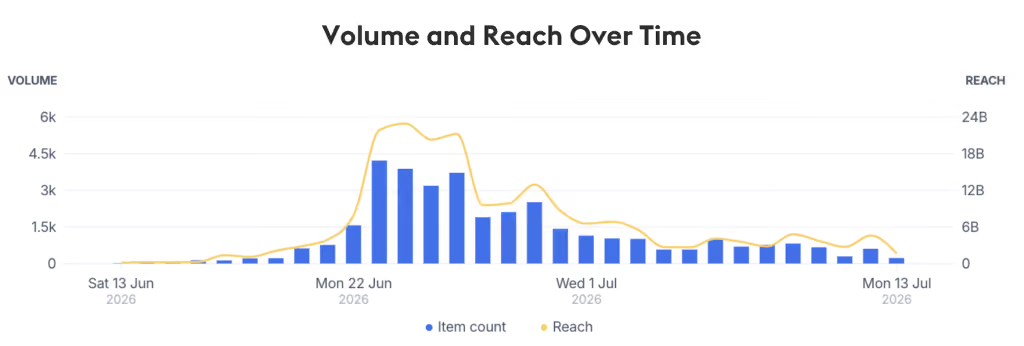
The narrative peaked June 22–25 at 4,500+ articles. By early July, it had moderated to ~500–700 daily. A narrative can spike and cool while still spreading through supply chains. Signal AI shows you not just volume dropping, but composition: which suppliers are still mentioned, which competitors show strain, which insurance signals are still rising.
Companies tracking this in real time ask the right questions: Is the disruption resolved, or just less newsworthy? Which entities are still showing operational strain? The companies staying ahead watch composition shift as secondary effects spread.
Final thoughts
Extreme heat created headlines that faded by early July. But on Signal AI's platform, secondary supply chain effects were still accelerating. The companies that win don't wait for coverage to return to zero; they track where environmental disruption is still spreading.
Set up real-time monitoring that connects primary events (environmental disruptions) to secondary impacts (supply chain strain). Watch which suppliers and competitors are still mentioned as headlines cool, and map them against your footprint.
Environmental risk doesn't follow news cycles. Your monitoring shouldn't either.
Methodology
Signal AI's risk intelligence platform analyzed the last 30 days of supply chain disruption signals across energy, logistics, semiconductors, cloud infrastructure, and insurance in Europe. June 13–July 13, 2026.
Additionally, Signal AI tracked the narrative search ("heat wave" OR "heatwave") AND ("supply chain" AND "disruption" AND "operations"), filtered to Europe.
Resources:
- European heatwave damps sales growth at clothing retailer Uniqlo
- Extreme heat forces early closure of Paris tourist attractions
- Disneyland Paris Suspends Outdoor Attractions Amid Historic Heat Wave This Week
- Eurostar cancels some trains between Paris and London amid heatwave
Now What?
You make critical decisions every day as a business leader. That’s why you need trusted data to help you build a more informed strategy and make more confident business decisions.
Signal AI helps you map your next move by delivering market trend analysis that highlights both hidden business risks and whitespace opportunities, giving you the foresight to shape your long-term plan.

Join the ‘Beyond the Register’ Webinar
Signal AI’s Director of Product, Tara Lynch, sits down with Damian Cobbold, CRO at Coforge, to explore what modern risk management looks like in practice. Drawing on his experience, Damian brings a cross-sector perspective on where risk functions are getting it right, where they’re still catching up, and what separates teams that surface risk early from those that find out too late.