
Welcome to Signal in the Noise, where we show you the real-world impact behind trending news.
Leadership transitions have dominated headlines. From Apple's planned succession to leadership shakeups at Walmart, Target, and Coca-Cola, and beyond, CEO transitions and succession plans have become some of the most scrutinized corporate moments by investors, employees, and the media alike.
That’s why Signal AI analyzed 22,400 pieces of CEO transition coverage across three different archetypes: Forced Departures, Founder-Veteran Return, or Planned Succession. The 2026 CEO Transitions Report maps how each archetype affects sentiment, salience, coverage volume and quality, and Tier 1 penetration. The findings are unambiguous: the type of transition is the single strongest predictor of reputational outcome.
The question we're asking: Does how you plan a CEO transition predict the reputational outcome?
1. Planned successions earn 2x as much positive coverage as forced departures
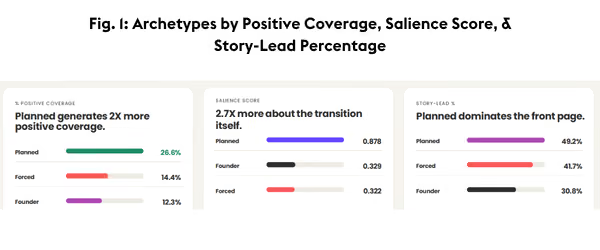
Companies with planned successions earned nearly twice as much positive coverage as forced departures. They also achieved a 2.7x higher salience score, meaning coverage stays focused on the leadership story rather than expanding into broader company issues.
Nearly half of all planned succession coverage (49.2%) led with the transition itself, while forced departures were far more likely to become part of a wider negative narrative.
2. Internal promotions are a reputation advantage, with more positive sentiment
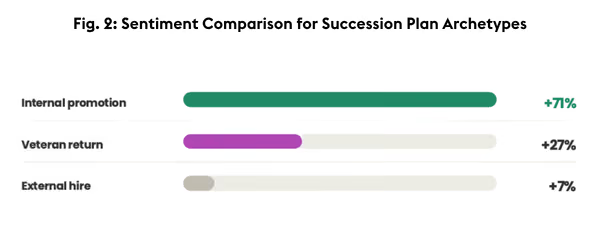
One of the clearest findings wasn't about when companies announce a transition; it was who they choose.
Incoming CEOs promoted from within averaged +71% positive sentiment. External hires averaged just +7%. The strongest-performing transition in the dataset, Dow's succession from Jim Fitterling to Karen Carter, combined three ingredients:
- A planned succession
- An internal successor
- Six months of preparation before the announcement
The communications strategy wasn't reacting to the story. It had already shaped it.
3. Case study: Outgoing CEOs receive 8.2x more coverage than incoming leader
Across the dataset, the outgoing CEO received 8.18x more coverage than the incoming one.
That means your successor inherits more than a title; they inherit the media narrative surrounding the person they're replacing. If the outgoing CEO leaves under pressure or uncertainty, that story can overshadow the incoming leader before they have a chance to establish their own.
Apple illustrates this well. Tim Cook's succession followed many best practices: a planned timeline, an internal successor, and years of preparation. Yet coverage remained heavily skewed toward the negative because the media conversation shifted less toward the successor and more toward the uncertainty of replacing one of the most influential CEOs of the past two decades.
Even iconic leaders don't outgrow transition risk. They simply require stronger narrative planning.
Final thoughts
Every top-performing transition in the dataset shares the same three-part structure: a planned succession, an internal hire, and an outgoing CEO with positive exit sentiment. None of these factors is enough on its own. Together, they give the media one clear story to tell.
The lesson for communications leaders is that reputation during a CEO transition isn't built on announcement day. It's built months beforehand.
The organizations that outperform aren't communicating faster. They're preparing earlier.
Methodology:
Signal AI analyzed 22,400 pieces of coverage across three CEO transition archetypes: Forced Departures, Founder-Veteran Returns, and Planned Successions. Coverage spanned April 2025 to May 2026. Classification was based on public announcement context, board statement language, and Signal AI editorial coding. Metrics tracked: all mentions (coverage volume), net sentiment (ratio of positive to negative coverage), salience (how central the CEO is to an article, scored by mention frequency, position, and length), and Tier 1 penetration (percentage of coverage in Bloomberg, Reuters, and The Wall Street Journal). Sentiment and salience were scored at the level of each executive mention.

How CEO Transitions Shape Reputation
Using Signal AI reputation intelligence, this report analyzes 22,400 pieces of coverage across three transition archetypes: forced departures, founder-veteran returns, and planned successions.