
If you’re in marketing & communications, you know acronyms are nothing new. Think: ROI, CTA, and CTOR, to name a few. Now, Generative Engine Optimization (GEO) is the buzziest new acronym everyone’s asking about.
As artificial intelligence and generative AI tools reshape how people find and consume information, a fundamental shift is occurring in the digital landscape. GEO is adding new pressures for brand visibility and organic traffic to company websites.
As more people start seeing results from tools like ChatGPT, Perplexity, Gemini, and Anthropic’s Claude AI, the question keeps coming up: How do we get our brand name to appear on this new channel? And not only appear but also represent our brand the way we want?
If you’re in Marketing, PR, and Communications, here’s the need-to-know on all things GEO and how it affects reputation management.
Key summary:
- What is GEO, and how is it different from Search Engine Optimization (SEO)? GEO is the practice of creating and optimizing owned content to be easily discovered, understood, and used by AI chatbots and generative search engines.
- What are the challenges of GEO today? The GEO market is nascent. The probabilistic nature of large language models (LLMs) and the unknowns of content ingestion mean challenges in monitoring for reputation management and measuring overall success.
- How does GEO impact reputation management, and what are the solutions? In the broader Communications landscape, it’s still about owning your corporate narrative with data-driven analysis, creating high-quality content, and choosing the right channels.
What is GEO?
Generative Engine Optimization (GEO) is an emerging practice focused on creating and optimizing owned content to be easily discovered, understood, and used by AI chatbots and generative search engines.
The term is also commonly referenced as:
- Answer Engine Optimization (AEO)
- Artificial Intelligence Optimization (AIO)
- Large language model optimization (LLMO)
- AI Search Optimization (AISO)
- Generative Search Optimization (GSO).
GEO represents the natural evolution of Search Engine Optimization (SEO) in an AI-driven world. SEO’s goal is similar to GEO’s: to show up where consumers are looking for you and lead them back to owned and branded content, like your website. The ultimate goal of GEO is to position your brand as a credible and authoritative source for these new AI-driven platforms.
Why is GEO important for reputation management?
- The future of search: Traditional search engines like Google Search and other platforms are increasingly integrating LLM-powered features. According to research conducted by Advanced Web Ranking (AWR), AI Overviews are now appearing in 42.5% of search results, affecting clickthrough rates for informational queries.
- Building authority and trust: Like SEO, the goal is brand awareness and building authority and credibility as a trusted source for information. As AI models cite your content as a source, it validates your brand’s expertise and builds trust with a new kind of audience.
- New metrics, new channels: LLMs mentions, or AI citations, are a new channel for measuring the impact and influence of owned and earned content beyond traditional web traffic and media placements. As this market matures, the ways to track, monitor, and measure will too.
How is GEO different than SEO?
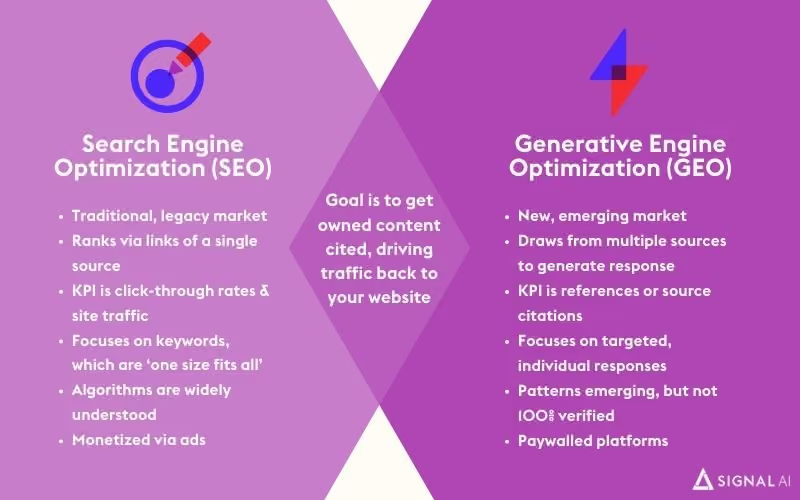
While there are many similarities (which, in turn, are causing much chatter and confusion), there are some key differences of note.
While many claim SEO is dead or dying, that's not the whole story. On Lenny's Podcast 'The Ultimate Guide to AEO,' Ethan Smith, CEO of Graphite, put it this way: "Google's slice of the pie stays the same - the pie gets bigger."
Google Search and best practices for ranking on search engines stay the same, but now there's a new set of strategies and tactics for LLMs.
While SEO focuses on optimizing content to rank higher in traditional search results, GEO centers on ensuring your brand is accurately represented and favorably positioned within LLM responses.
Rather than pulling information around specified keywords to rank high on a results page, LLM responses synthesize their answer to user requests by drawing from multiple sources, integrating and summarizing them by generating new text. This means multiple sources can be linked in a response.
Unlike rankings on a Google results page, where you can be the first hit, it’s not realistic to expect your website to be the single source of an LLM response.
It’s important to recognize the biggest difference between SEO and GEO: SEO is a legacy practice where the algorithms behind the search engine rankings are clear. With GEO being so new, there is no clear, certified answer on how to get picked up or cited by LLMs—only speculations. However, data shows that 80-90% of LLM responses rely on earned media rather than a company’s owned content. This means PR & Communications efforts can directly impact LLM citations.
What are the challenges of GEO for reputation management?
Controlling the Narrative
PR and communications strategies have always been about controlling the narrative and influencing the sources that AI models are now relying on. When someone asks ChatGPT, Claude, or Google's Gemini about your company, industry, or executives, what narrative emerges? More importantly, how consistent is that narrative across different AI platforms and over time?
This is where GEO presents a new challenge: How do you control output that varies across tools, over time, and depending on the person asking?
The Content Ingestion Challenge
Marketing and communications teams are increasingly focusing on creating messaging that's most likely to be ingested and accurately represented by AI systems. This requires understanding how LLMs source, process, and synthesize information about your brand. Teams need visibility into whether their messaging strategies are working. Essentially, they need to know if they're "winning" in generative search.
Most tools in the GEO space rely on scores and assumptions. In comparison, AI Citations show the actual prompts, responses, and sources behind AI answers. Combined with readership data, this can reveal not just what drives visibility in AI, but what drives real-world impact.
The ‘Probability’ Problem
Communications teams will increasingly value the capability to monitor how different LLMs portray their brand. However, this monitoring comes with significant caveats. Essentially, LLMs can hallucinate, and their responses are inherently inconsistent.
The probabilistic nature of LLMs means that the same question asked twice—even moments apart—can yield vastly different responses. Your brand might be portrayed positively in one AI interaction and neutrally or negatively in another, making traditional monitoring approaches difficult and insufficient.
In comparison, AI Citations ask a consistent set of persona and focus area driven questions across the models on a regular cadence, which analyzes patterns in responses, brand mentions, and narrative shifts over time.
Monitoring & Measuring Success
In ‘GEO Guidelines’ from Jakob Nielsen, he explains the reality of GEO’s current state: "Measuring success remains difficult. AI results are probabilistic because identical prompts generate different answers. These companies might resemble early SEO consultants, claiming credit for improvements that would occur anyway or can’t be definitively attributed.”
Some legacy tools already established in the SEO market are making the shift to GEO, like Ahrefs' new Brand Radar, which tracks mentions in AI Overviews, or SEMRush. Some companies might promise to get you cited on LLMs, but like SEO, meaningful results will require effort, high-quality content, and technical expertise—not quick fixes or magical solutions.
Today’s GEO tools go off of guesswork, promising to get your owned content cited; but the earned media piece leaves a gap that GEO tools can't fill. AI citations brings visibility into which earned media articles LLMs rely on.
The Solution: A Balanced Approach to GEO for Reputation Management
While the challenges are real, GEO isn't something to ignore. Here's how to approach it strategically:
Prioritize the Right Channels for your Brand
From a Marketing standpoint, this is the common practice of backlinking. As discussed, citation behaviors vary. If you want to be cited by everyone, you need to cover your bases: be on Wikipedia for ChatGPT, Reddit, or community discussions for Perplexity, have structured how-to or FAQ content for Bing, and maintain overall authority signals for Google’s systems.
Remember that reputation management extends far beyond owned channels. Continue monitoring broadcasts, podcasts, print media, and traditional outlets while adding AI-generated content to your surveillance mix.
Clean Up Content
Best practices for GEO are similar to SEO:
- Code site pages for faster loading and good readability scores for easier scanning
- Leverage schema markups, anchor links, and key summaries to build a clear content structure
- Prioritize conversational, informal language that doesn’t focus on keyword stuffing, but actually answers user questions.
Focus on Quality Content Creation
The best way to understand your brand reputation, perception, and your messaging is to first analyze trusted data points to determine what storylines are shaping the industry's conversation.
Instead of trying to game AI systems, focus on creating high-quality, authoritative content that accurately represents your brand. This includes informative, unique thought leadership pieces that stand out amid the noise.
Looking Forward
GEO represents both an opportunity and a challenge for reputation management. Understanding how AI systems discuss your brand will become increasingly important as these tools gain adoption.
The key is approaching GEO with realistic expectations, focusing on foundational content quality, and maintaining the broader perspective that reputation management encompasses far more than any single channel—digital or otherwise.
As the AI landscape continues evolving, successful reputation management will require balancing innovation with skepticism, ensuring that the pursuit of GEO doesn't overshadow fundamental communications principles.