Welcome to Signal in the Noise, where we show you the real-world impact behind trending news.
Geopolitical shocks have accelerated from boardroom concern to operational crisis. European natural gas prices doubled in early March 2026 when Middle East tensions threatened the Strait of Hormuz. Shipping carriers rerouted around the Cape of Good Hope, adding 10–14 days to Asia-Europe voyages. Hapag-Lloyd swung from a €463 million profit to a €256 million loss in a single quarter. Meanwhile, 50% of global executives now expect the next two years to be stormy or turbulent, a 14-point spike from the prior year.
That's why Signal AI analyzed 50+ global brands and tracked over 4 million articles published on geoeconomic conflict between Q4 2025 and Q1 2026. We mapped five active flashpoints, measured search-volume spikes across risk categories (international trade risks jumped 41.8%), and identified a critical gap: most organizations are still monitoring what happened rather than predicting what's next. The finding is clear: the companies that survive aren't the ones with the best crisis response. They're the ones that embed geopolitical forecasting into their core risk function before the crisis hits.
The question we're asking: Are you monitoring geopolitical risk, or managing it?
1. Geopolitical conflict just became the top risk for the first time ever
Here's what surprised us: 50% of global leaders now expect the next two years to be stormy or turbulent. That's a 14-point jump from last year.
But the real shift is this: geoeconomic confrontation including trade wars, tariff threats, sanctions escalation is now the #1 short-term risk. It knocked out all the other concerns. On our platform, we saw over 4 million articles published about this between January and May 2026.
What this means for you: The old playbook doesn't work anymore. Tariffs aren't stable, sanctions shift by the hour, and trade routes close overnight. They're being actively weaponized by states against competitors and rivals.
2. Hapag-Lloyd lost a quarter-billion euros. Here's what that shows us
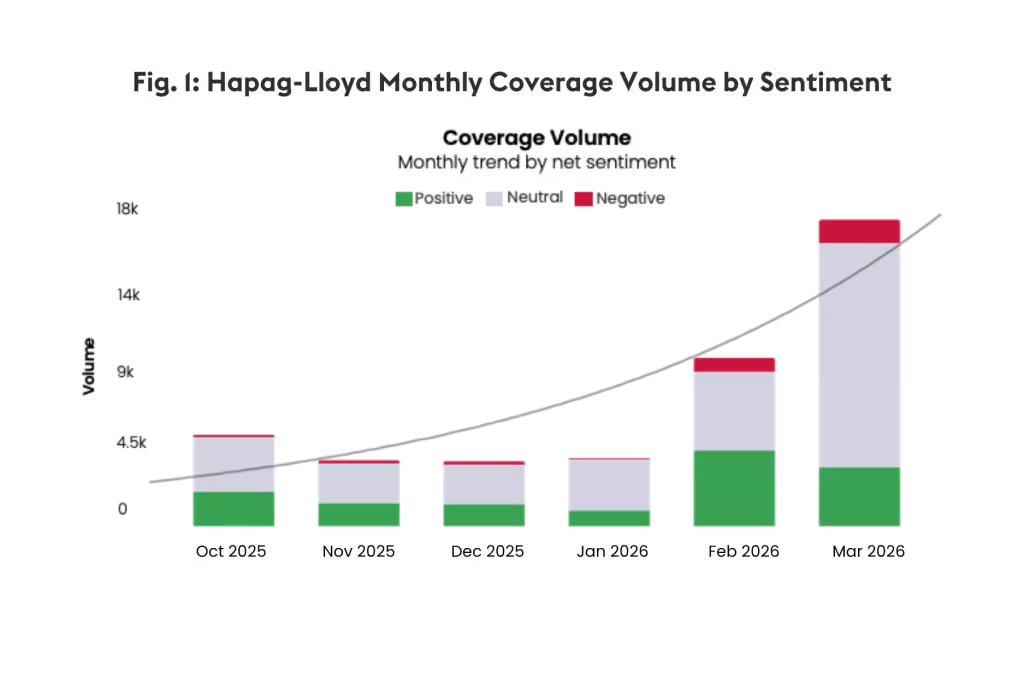
Hapag-Lloyd is one of the biggest shipping companies in the world. In Q1 2026, Hapag-Lloyd's war-risk insurance alone cost €40–50 million per week. Combined with fuel surcharges and the Strait of Hormuz blockade, the company swung from a €463 million profit (Q1 2025) to a €256 million loss.
As coverage volume climbed, sentiment deteriorated, and markets spiraled. What began as operational disruption became a confidence crisis.
This is what matters for risk teams: There's a difference between monitoring what happened and predicting what's next. One tells you the price of a mistake while the other prevents it.
3. Five flashpoints lighting up right now and the cascades they'll trigger
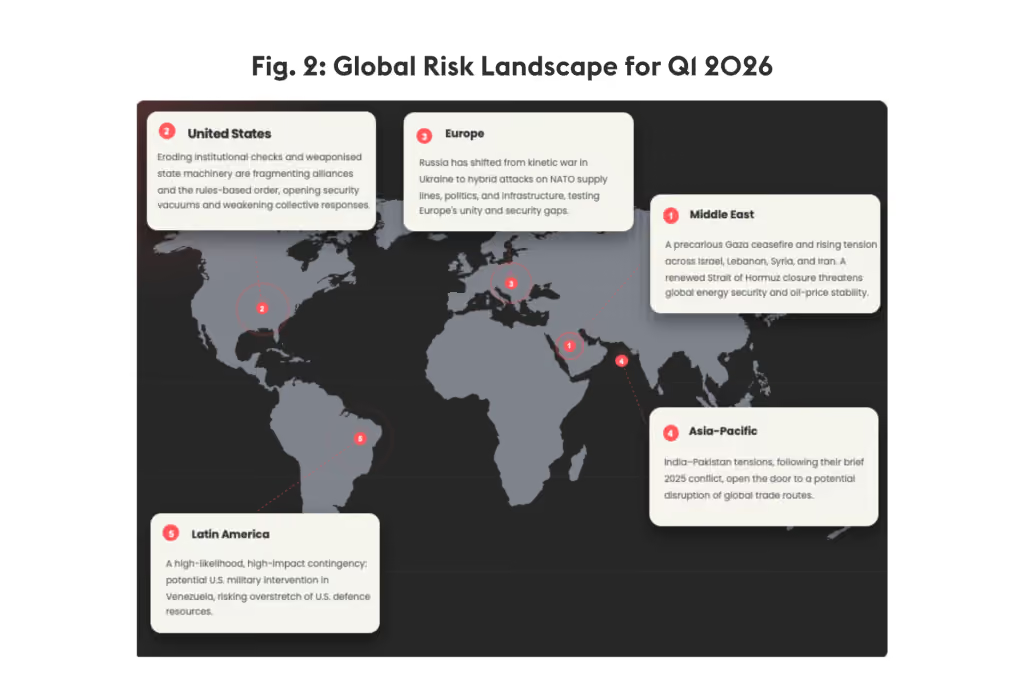
The Middle East is facing Strait of Hormuz closure threats, Israel-Iran escalation, and energy price spikes that ripple across global markets.
Europe now contends with Russia shifting from direct war in Ukraine to hybrid attacks on NATO supply lines and critical infrastructure.
Asia-Pacific remains volatile: India-Pakistan tensions, still raw after their 2025 conflict, continue to threaten major trade routes and regional stability.
Latin America faces potential U.S. military intervention in Venezuela, triggering supply shocks and forcing companies to price in regime-change risk.
Across all regions, tech decoupling is accelerating. Tariffs stack on tariffs. Supply chains fracture by geography, forcing companies to choose: regionalize or lose market access.
International trade risks jumped 41.8% in search volume and activism risks spiked 37.4%. If you're waiting for a crisis to respond, you're already behind. The companies that survive build supply-chain redundancy now, track policy shifts continuously, and stress-test against scenarios that seem unlikely but carry high impact.
Final thoughts
Geopolitical risk is no longer a comms footnote or a quarterly board mention. It is a structural feature of global operations and a daily driver of shareholder value. The organizations that outperform are those that embed geopolitical forecasting into their core risk function, move from reactive monitoring to predictive scenario planning, and treat chokepoint vulnerability as a permanent strategic planning constraint.
The data is clear: the world your contracts were written for no longer exists. The one ahead requires a different model.
Methodology
This edition draws from a proprietary analysis of 50+ global brands across shipping, energy, technology, agriculture, construction, travel, and pharma, conducted by Signal AI between Q4 2025 and Q1 2026. Analysis tracked search-volume growth and sentiment shifts across traditional media, regulatory content, and social channels on the Signal AI platform. Key data points reference the World Economic Forum's Global Risks Report 2026, Hapag-Lloyd's financial disclosures, and verified market reports on energy pricing, maritime disruptions, and tariff impacts. Percentages reflect year-over-year changes in media exposure and narrative volume for named risk categories.
Resources:
- 2026 Geopolitical Risk Report (primary source)
- World Economic Forum Global Risks Report 2026 (January 14, 2026)
- Hapag-Lloyd Q1 2026 Financial Results
- Signal AI Risk Intelligence platform
Now What?
You make critical decisions every day as a business leader. That’s why you need trusted data to help you build a more informed strategy and make more confident business decisions.
Signal AI helps you map your next move by delivering market trend analysis that highlights both hidden business risks and whitespace opportunities, giving you the foresight to shape your long-term plan.

Top Emerging Risks Impacting Businesses in 2026
For the first time, the World Economic Forum ranks geoeconomic confrontation as the single most severe short-term global risk, ahead of extreme weather, misinformation, and armed conflict. Signal AI’s platform data shows the same shift inside enterprise risk signals: trade, activism, and regulatory volume all rose sharply between Q4 2025 and Q1 2026, concentrated in a small set of industries with the least room to absorb the shock.