Most platforms wrap AI capabilities around Boolean. We’re built on a decade of AI, not a layer of it.
Signal AI started with a clear premise: artificial intelligence should completely change how organizations understand risk and manage reputation. For more than a decade, that focus has driven our technology.
As AI reshaped every corner of the enterprise, media intelligence platforms faced a choice. The response, for most, was predictable: wrap AI around Boolean. Use a large language model to write the search strings. Cleaner syntax, faster to generate, but with the same fundamental limitation underneath. A document either contains your keywords or it does not. Boolean written by AI is still Boolean.
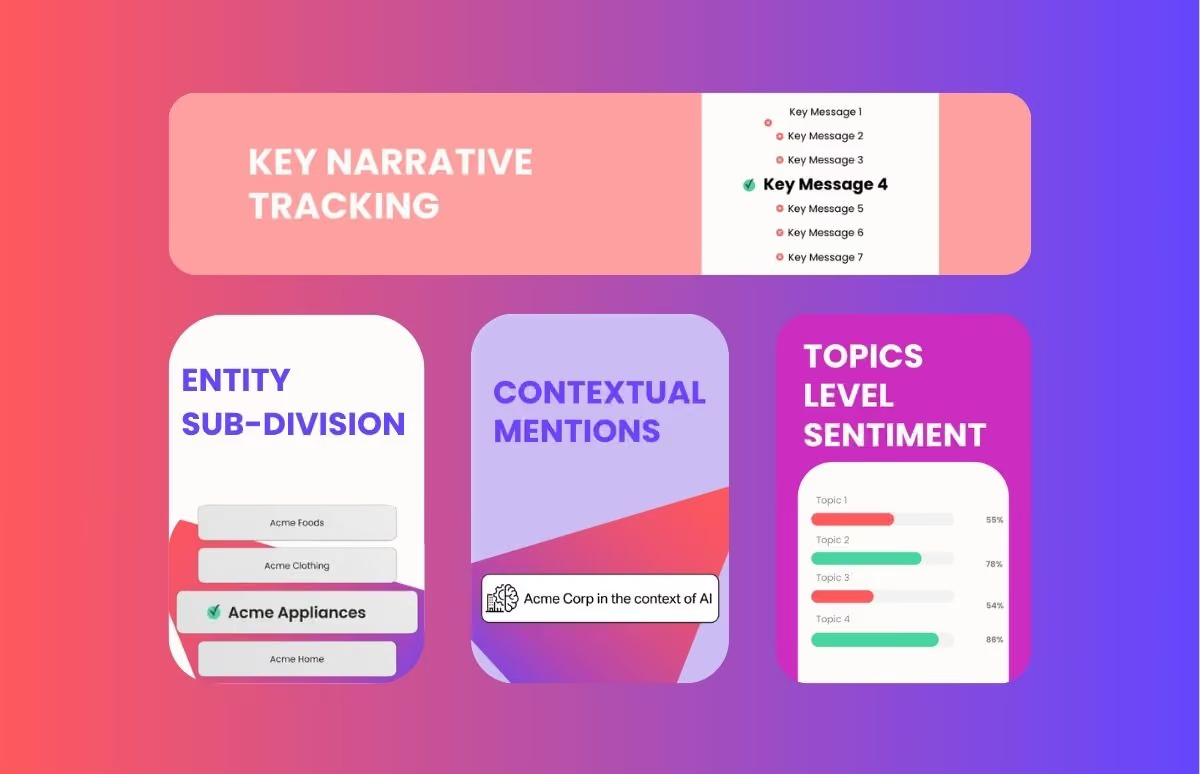
For the first time, corporate communications and risk teams can track how a specific message lands across channels, isolate brand mentions that are genuinely connected to a topic, and understand sentiment at the topic level, not just the brand level. For Boolean-based platforms, these problems remain out of reach. This is what AI-native Search 2.0 makes possible.
Our proprietary AI engine, AIQ, labels 100M+ entities and topics every day. That’s not a feature added to keep pace with a trend. It is the foundation on which everything we build sits, and it is what Search 2.0 is built on.
AI has always been at Signal AI's core. Now you can shape it around your needs.
Instead of translating complex business questions into keyword logic, you can now define what matters in plain English. The platform dynamically builds custom labels tailored to your specific enterprise needs, shifting your workflow from manual data cleanup to actual analysis.
Here’s what Search 2.0 makes possible for the first time:
Follow how a key message and its variations spread across channels
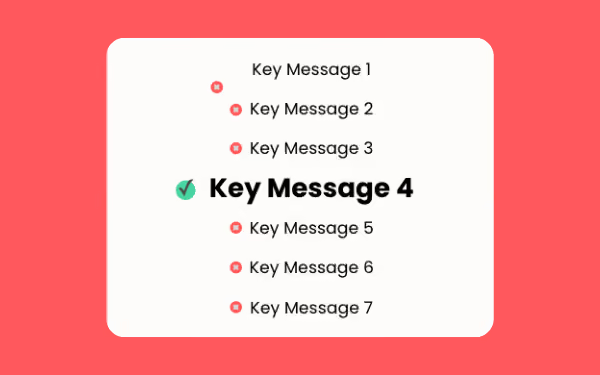
Keyword rules cannot predict how a story evolves. By defining a custom label for a specific campaign, press release, or public statement, you can track the Key messages to monitor their exact lifecycle as it ripples across channels, capturing every variation without anticipating it in advance.
Isolate your brand's meaningful connections to a topic, not just mentions across articles
Legacy topic tags operate at the full-article level, falsely linking brands with themes that simply appear in the same piece of text. Find Contextual Mentions, use Search 2.0 to analyze context at the sentence and paragraph level, ensuring your brand is only surfaced when it is meaningfully connected to the topic you care about.
Track subbrands within complex corporate structures

When entity mentions are treated as a single undifferentiated brand, granular tracking becomes impossible. Search 2.0 lets you instruct the AI to isolate Corporate Divisions, or distinct sub-brands within a complex corporate structure, keeping your data sets clean and separate.
Precise sentiment analysis for your brand being discussed in relation to specific topics
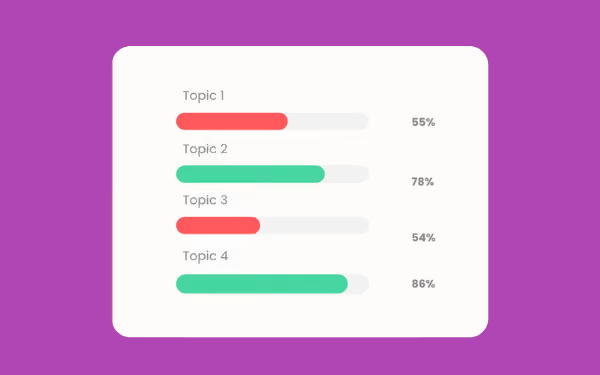
Most media intelligence tools can only tell you how your brand is being discussed overall. Search 2.0 makes sentiment available at the topic level, so you can understand not just when a specific issue appears alongside your brand, but how it is being framed in that context. Whether it is electric vehicles, executive moves, or a regulatory change, you get a precise read on how that topic is landing in relation to you, not just across the media landscape broadly.
Want to try search that’s engineered for precision?
By using an AI engine that labels 100M+ entities and topics every day, we turn the world’s unstructured media data into clean, structured knowledge. This ground-up approach gives corporate communications and risk leaders total data confidence, freeing up team energy to focus on strategy, mitigation, and action. To see what our AI-powered Advanced Search can do, book a demo.