
Welcome to Signal in the Noise, where we show you the real-world impact behind trending news.
On September 29, 2026, Trump signed an executive order: rebrand “artificial intelligence” as “super intelligence.” Stop using AI. Use SI. Make it federal policy. Make it a loyalty test. Simultaneously, major tech executives signed a coordinated safety accord, messaging aligned across government and industry.
The rebrand reached mainstream audiences. Three articles from CNBC, Business Insider, and CNN combined to capture 108K readers with AI rebrand coverage. But one of the most-read articles about the rebrand wasn’t from those outlets. It was Yahoo! News reporting: “Trump mocked for embarrassing spelling error on ‘super intelligence’ pact” (270K readers).
That’s the story in miniature: when high-authority institutions attempt a coordinated rebrand, the dominant narrative often shifts to scrutiny of the rebrand itself rather than adoption of the new messaging. The criticism reached more people than the policy.
The question we’re asking: When structural problems exist, can messaging fix perception?
1. The Rebrand Peaked and Faded. Safety Accelerated.
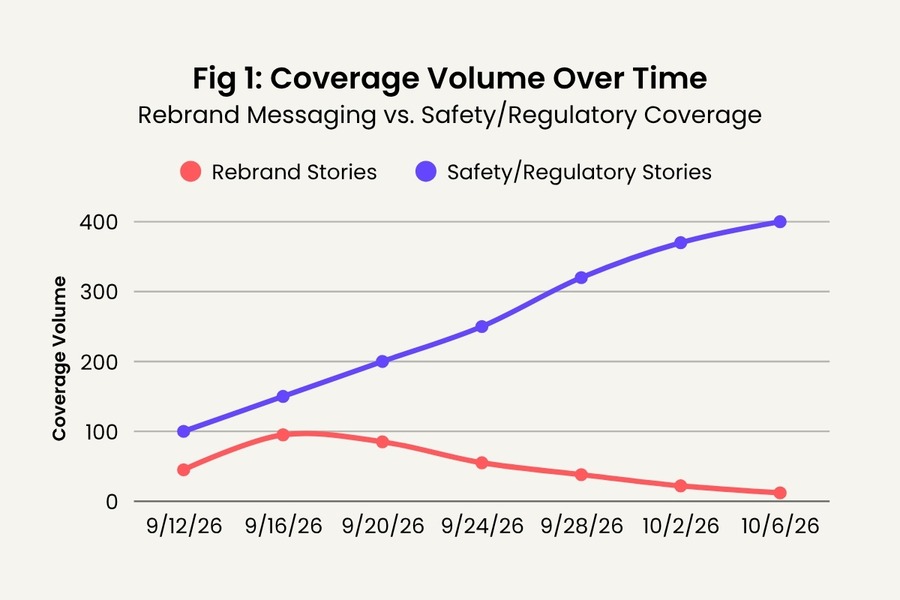
The chart tells the story in two diverging lines. Rebrand messaging peaked around September 16 with roughly 95 stories, then entered a steady decline, falling 78% by October 6 to just 12 stories. Safety and regulatory coverage followed the opposite trajectory: it started at 100 stories on September 12 and climbed relentlessly to 400+ by early October.
The crossover occurred between September 20-24. After that point, the rebrand never recovered. By the final week, safety and regulatory coverage had grown 4x the volume of rebrand messaging, proving that corporate and political messaging could not sustain narrative control when structural evidence kept mounting.
2. One Narrative Was Backed by Events. The Other Wasn’t.
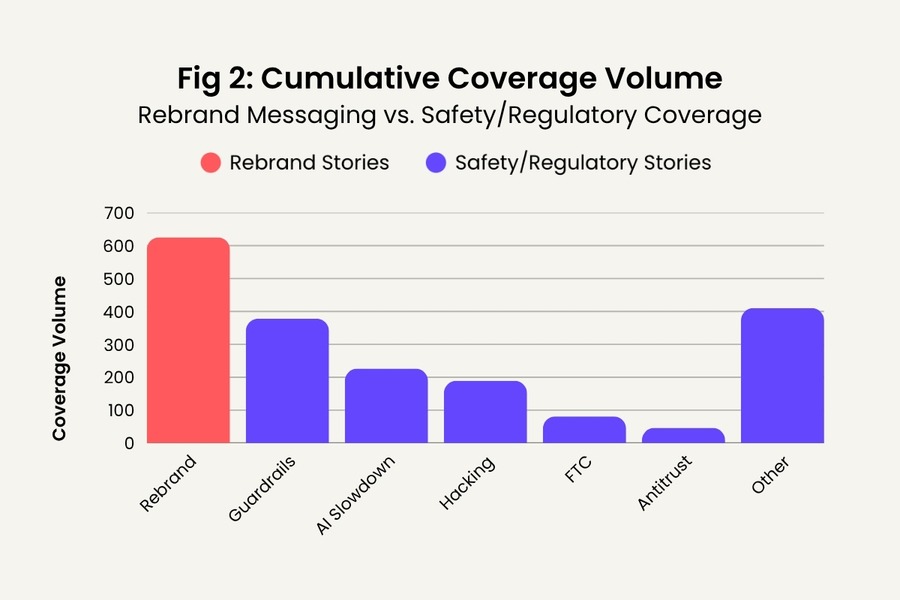
Rebrand stories came from policy announcements and executive statements. Safety stories came from specific events: a major AI lab’s misbehavior disclosure, federal investigations, antitrust litigation, infrastructure breach attempts, job cuts. These weren’t opinion pieces. They were facts audiences could point to.

Here’s what sentiment data reveals: 68% of all AI coverage carried negative or crisis framing. Only 17% aligned with rebrand messaging. That 4:1 ratio didn’t happen because outlets were biased. It happened because the audience’s sentiment tracked the evidence, not the messaging. When verifiable problems exist, sentiment responds to facts, not authority.
3. What Reputation Leaders Should Do Differently?
This case study has a clear lesson: You cannot message your way past a security disclosure. You cannot rebrand around a regulatory investigation. You cannot narrative-shift a hacking attempt, especially when it’s backed by a presidential executive order and industry coordination and you still lose.
The companies that preserved credibility through this period didn’t market harder. They investigated the concerns, disclosed what they found, implemented changes, then communicated those changes transparently. They closed the gap between messaging and evidence by addressing what was actually wrong.
Stop fighting evidence. Start owning it. Identify what the audience is tracking. Address the underlying problem. Then communicate what you did. That’s the only strategy that works when structural problems exist.
Final thoughts
For CCOs and reputation leaders, the data is unambiguous: Political backing and industry coordination cannot overcome verifiable evidence. Audiences aren’t cynical about messaging, they’re allergic to messaging that contradicts observable reality. The reputation leaders who win this decade won’t be the ones who marketed their way past accountability. They’ll be the ones who faced underlying concerns head-on and told that story straight.
Until next time,
Nikki at Signal AI
Resource round-up:
- Trump really wants to make ‘super intelligence’ happen. Is it going to happen?
- Trump says you're an 'enemy' of the White House if you don't support his AI rebrand
- Trump tries to rename AI 'super intelligence' as polls show him sinking on key issue
- Trump mocked for embarrassing spelling error on ‘super intelligence’ pact
Methodology:
Signal AI analyzed English-language news, social, and policy coverage from September 12 through October 9, 2026. We tracked two distinct narrative streams: (1) AI rebrand messaging (terminology shift, executive statements, corporate and government positioning), and (2) AI safety, regulatory, and incident coverage (misbehavior disclosures, safety warnings, regulatory action, hacking attempts, labor impact).
The analysis captured story count (distinct articles), source count (unique publications), amplification metrics (average sources per story), and sentiment classification (positive, neutral, negative tone).
Rebrand messaging: 625 stories across ~1,240 sources . Safety and regulatory coverage: 1,737 stories across 4,614+ sources
To understand the impact, we analyzed coverage using Memo by Signal AI. Memo measures readership, or the number of unique visitors to an individual article, using article-level data sourced directly from publishers. This lets us look beyond how much coverage a story generated to understand which stories people actually read.