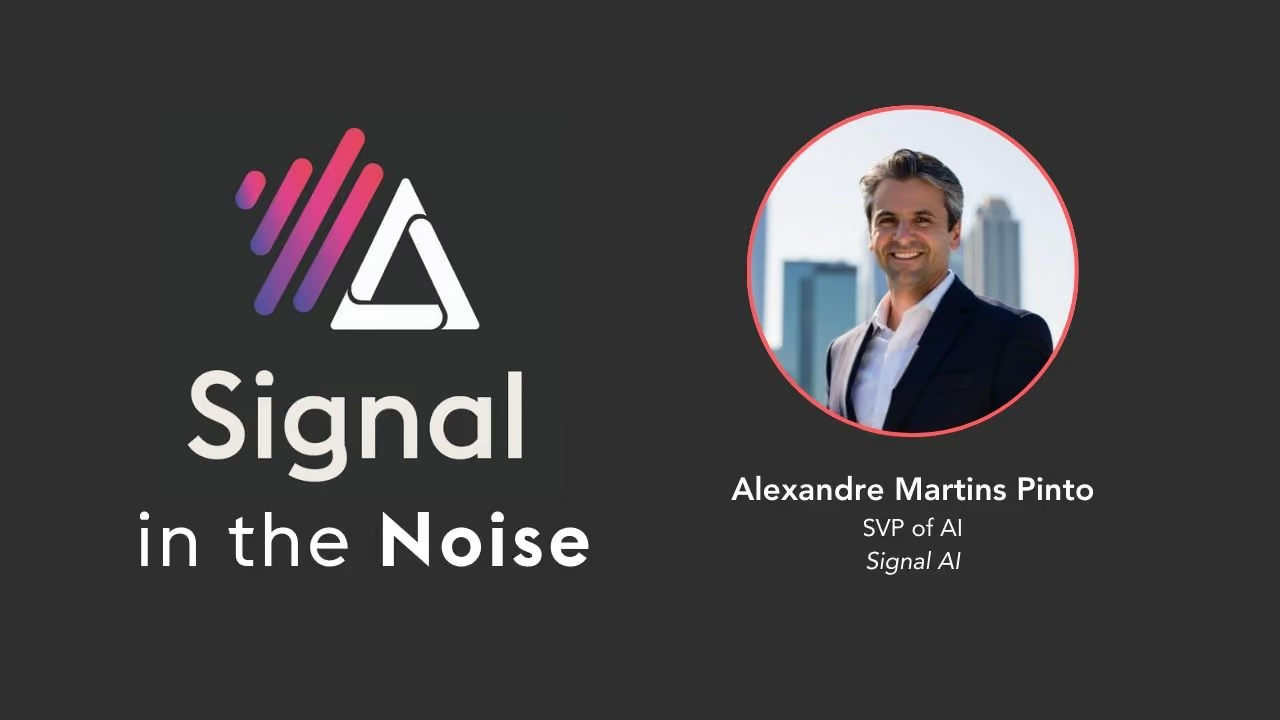
On this episode of Signal in the Noise, we have a special guest and colleague join us: Alexandre Pinto, SVP of AI at Signal AI. We get a crash course in all things AI - including Agentic AI, LLMs, and retrieval-augmented generation (RAG).
We cover your most pressing questions about AI, including: What is an AI agent, and how are they being deployed in the corporate context? How is our AI learning and evolving to disrupt the risk and reputation landscape? What's Alex's vision for the future of agentic AI?
Below is just a snippet of the conversation. For more episodes, check out the Spotify channel to listen or the YouTube channel. This transcript has been edited for length and clarity.
" The notion of an AI agent is really old. Now, with the LLMs powering this new way to interact with AI [...] the technology gives it a whole other dimension." - Alexandre Pinto, SVP of AI, Signal AI
Dan Gaynor: Let's start with what an agent is. What is an agent? Because it's the new word in AI, by the way. Your point about working on Gen AI decades ago is very resonant because everyone thinks it just came out. Have agents existed for a long time? Who are these robots in our pockets?
Alexandre Martins Pinto: The notion of agent is much older than the notion of generative AI. If you go back to the first book that was used by universities across the world as the Bible to teach AI, Chapter Two is entirely dedicated to that, and it was published in 1995, so 30 years ago, when I started studying AI. So Agentic AI and the notion of an agent is really old in that sense.
Now, with the LLMs powering this new kind of way to interact with AI, and now, of course, we label this as agentic AI. It all seems absolutely brand new, but the concept is not new at all. Of course, the new technology gives it a whole other dimension.
DG: Let's talk about that. So could you just first define what an agent is for people who frankly only know about maybe chat GPT operators?
AP: So, very simply, an agent is a piece of software that is able to perceive the world, reason about it, and with its own beliefs, desires, intentions, or knowledge, and has the capacity to act in the world.
That's it—to pursue its goals. And if you say this, almost everything falls into this description. If you have an AC, equipment with a thermostat can sense the temperature of the environment, and it can turn on or off automatically to achieve its goal, which is the desired temperature. Fine. Yes. In a sense, yes.
That's a very simple agent. It's a very non-intelligent agent, but it's an agent, so of course then, you can extrapolate all the way to Stephen Hawking - super incredible intelligent agent.
DG: So, right now, the world is really transfixed by agents that can run your laptop, right? They can go on. kayak.com, and they can look up a flight from Boston to Lisbon, and it can go all the way through. Do you want to pick your seat and do you authorize this purchase? In the consumer context, I'm interested in, in particular your world in the corporate context. We work here with some really big, sophisticated companies that have decisions that shake tens of millions of dollars one way or another. Tell me a little bit about how you're wrapping your head around the challenge of creating agents for corporate reputation and corporate risk management.
AP: So, I think we have, as you know, Ask AIQ, Signal AI's agentic interface that allows you to extract and get the reputation and risk intelligence profile for your company.
It leverages both discriminative and generative AI to its main branches, essentially AI to identify documents and risk events that are relevant to your company, your profile, and the companies that you care about. So, understand your question and break it down into a plan, which is what agents, like the one you were examining, break that analysis into a plan and then execute that plan.
In the case of Ask AIQ, it can use not only the usual suspects of skills, like taking a question and breaking it down into a plan and then executing it, but it can also use all the functionalities that our web app already has so it can do all those searches, all those fancy charts, and get all those trends.
So, it has all those tools ready to be used. I. It is a powerful thing to do because we are basically taking our own already existing platform, not breaking it apart, but extracting all of its components, making it into a toolbox.
" That's one of the mistakes that is most commonly found is that people think like LLMs, large language models 'know' things. They are large language models. They're not large knowledge models." - Alexandre Pinto, SVP of AI, Signal AI
DG: Let's discuss the machinery behind the scenes, and then we'll pivot to the product that people will be able to interact with, Ask AIQ. Do you want to explain RAG a bit?
Alexandre Pinto: RAG (retrieval augmented generation) is a technique that was born not too long after the Chat-GPT revolution and was born as a realization that if you just ask a Chat-GPT a factual question and for which you want a factual answer.
In some cases, you can get hallucinations - because what the model is essentially doing is just predicting the next word, technically a token, but I simplify things and just predicting the next word that it should write out as the answer. It's not drawing from any knowledge it has stored.
That's one of the mistakes that is most commonly found is that people think like LLMs, large language models "know" things. They are large language models. They're not large knowledge models. So if you want to get facts, it's more secure to ask Google for facts than if you want to create something new, ask Chat-GPT - fine,
but if you want to find facts, search for facts or ask AIQ because what Ask AIQ does is RAG, which is retrieval augmented generation. So you get your question, and you retrieve the documents that are relevant to your question like Google would do. So then now you get your facts and now you can generate some sort of summary for those bits and pieces of those arguments that really relate to your question.
Now you get a concise answer, so you generate it after retrieving it. It's your retrieval-augmented generation.
Dan Gaynor: I like to think of it like a private chef. There's one way to do it, which is 'What do you have in the fridge?' If you only have olives and three-week-old cheese, there are only so many things that you can create that are reliably good meals. But what RAG allows you to do is send a private chef out who grabs the documents, or in my analogy, the groceries, the ingredients that you would really want to make a really, in this case, delicious meal or accurate search happen.
---
Signal in the Noise is a podcast dedicated to helping today's business leaders navigate the complexities of decision-making by leveraging data and groundbreaking technology—first and foremost, artificial intelligence (AI). You can also watch the interview on our Signal AI YouTube channel here.