Agentic AI is certainly not a new concept in the timeline of AI developments—it’s been around for nearly three decades. Yet today, particularly in the business world, it’s the phrase on everyone’s lips, as McKinsey has called it, ‘the new frontier of generative AI.’
The promise of accelerated productivity and operational efficiency has likely driven this newfound intrigue. According to a recent KPMG Quarterly Pulse survey, 51% of organizations are actively exploring AI agents, with another 37% piloting their implementation. Adopting Agentic AI in enterprise settings is no longer a question of if but when.
Let’s define agentic AI, why you should know about it, and how it could come to transform the corporate world.
What is Agentic AI?
Our SVP of AI, Alexandre Pinto, explains a brief history of agentic AI in our latest Signal in the Noise episode, 'The Past, Present, and Future of Agentic AI':
“The notion of an AI agent is much older than the notion of generative AI, almost as old as the notion of artificial intelligence itself. If you go back to the first foundational book used by universities worldwide, Artificial Intelligence: A Modern Approach, first published in 1995 by Stuart Russell and Peter Norvig, you’ll find in the preface that ‘the main unifying theme is the idea of an intelligent agent.’”
What’s causing this newfound focus on AI agents? He explains: “Recent developments in large-language models (LLMs) are powering a new way to interact with AI, bringing us into a new dimension and giving new impetus to this field.”
The definition of Agentic AI
Agentic AI is a type of artificial intelligence or software that can perceive the world with its own set of beliefs, desires, intentions, or knowledge and, therefore, act independently to achieve its goals.
At a high level, an AI agent is an artificial intelligence program that can take a high-level task, objective, or goal that the user sets and then pursue that goal autonomously, with little to no human input or ‘human in the loop.’
In our everyday world, even our air conditioners are technically AI agents; they can perceive the outside world (the temperature) and act accordingly to their goal (changing the thermostat to achieve the desired room temperature).
https://youtu.be/ZCHJCyjbLiY
With Agentic AI, we can advance from answers to simple user requests to:
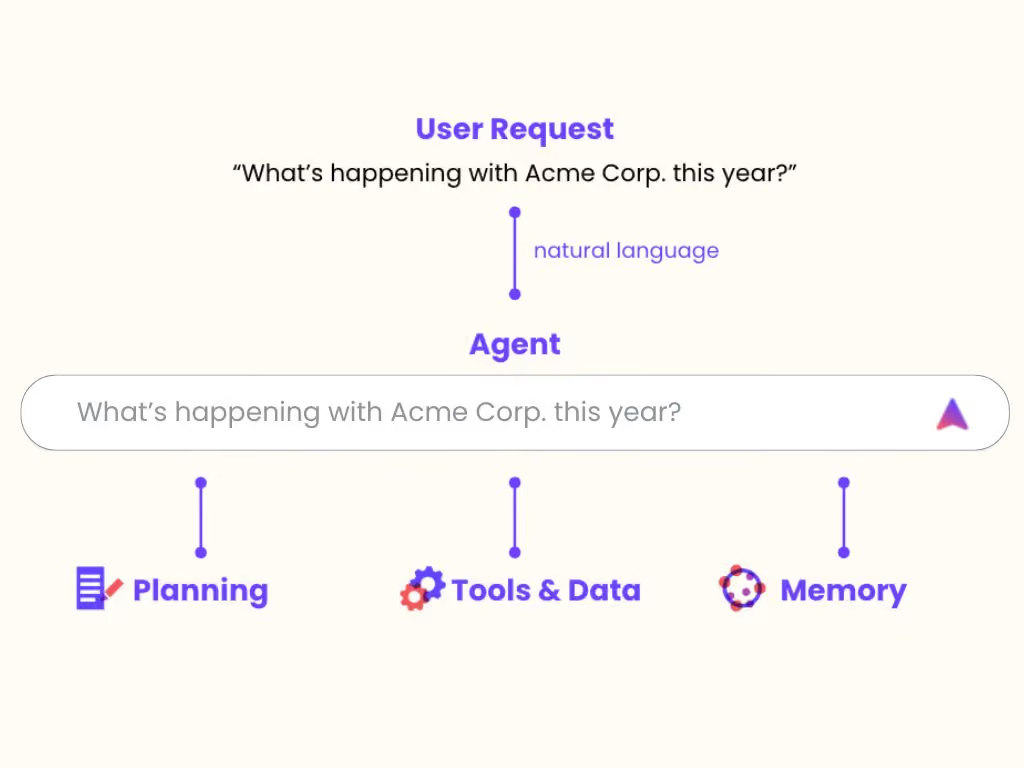
- Memory capacity: The AI agent can remember previously asked questions and analyses in saved conversation threads.
- Planning ahead: Capability to break down a complex goal or objective that you set for it into a set of steps that it needs to execute.
- Domain expertise: Retrieving high-quality data and accessible tools for more complex, sophisticated, and trusted answers.
Of course, scheduling ahead and memory elements are wonderful time-savers, but what’s most powerful about these forms of Agentic AI is their ability to analyze and problem-solve. Agentic AI models can retrieve the relevant information to answer your questions, process the necessary data, analyze in the desired formats, make decisions, learn from interactions, and take proactive steps toward answering complex business questions.
Depending on the dataset from which an Agentic AI model is retrieving information, the model will be able to provide more thoughtful responses specific to your organization's content, the user, and the context of the problem you're working on.
How does Agentic AI differ from other AI models?
Today, many AI phrases are making headlines, including LLMs, generative AI, discriminative AI, conversational AI, applied AI, and agentic AI. Let’s differentiate Agentic AI from other AI models.
AI agents differ from a large-language model (LLM) like Chat-GPT or Perplexity AI. LLMs excel at understanding and generating language, while AI agents use various tools, including LLMs, to autonomously perform tasks.
“The biggest misconception is that large-language models (LLMs) inherently know things,” Pinto shared, “We should remember that they are large-language models, not large-knowledge models.”
An LLM passively responds to prompts, whereas an AI agent actively makes decisions. Think of it like an employee who tends to sit back and wait to be told what to do, compared to a resourceful planner who proactively thinks ahead on what might be needed next and can solve problems independently.
Compared to other AI developments, from rules-based systems to machine learning, Agentic AI is the version of AI systems built with automation, goal-oriented behavior, and adaptability in mind. AI agents will move from just saying things, to now doing things.
Scenario: Planning a complex business trip
Imagine you need to plan a complex business trip. With a traditional AI model, you'd receive fragmented, disconnected assistance. You might ask an AI to find flight options, and it would return a list of flights. Request hotel recommendations, and you'll get a separate set of hotel suggestions. Ask about meeting scheduling, and you'll receive another disjointed set of time slots.
Traditional AI Scenario:
You: "I need to plan a business trip to San Francisco for a tech conference."
AI Response:
- "Here are 10 flight options between X and Y dates."
- "Here are 5 hotel recommendations near the conference center."
- "These are potential meeting time slots."
Agentic AI Scenario:
You: "I need to plan a business trip to San Francisco for a tech conference."
AI Response: "I'll help you plan this comprehensively. Let me break this down:
- Would you like me to start booking these arrangements, or would you prefer to review the options first?"
- Based on the conference dates, I've identified the most cost-effective and convenient flight options that minimize travel time.
- I've selected hotels near the conference center that match your company's typical budget and preferred amenities.
- I've analyzed the conference schedule and your existing calendar to recommend optimal meeting times with potential clients.
- I'll create a detailed itinerary, including transportation between the airport and hotel, and even suggest local restaurants near your meeting locations that can accommodate business discussions.
In summary, rather than providing disconnected information, Agentic AI:
- Understands context holistically
- Proactively connects different task components
- Makes strategic recommendations
- Anticipates potential challenges
- Offers end-to-end solution planning
What are the benefits of Agentic AI for reputation & risk professionals?
You can think of an intelligent AI agent as an additional member of your risk or reputation team who you can instruct in natural language to do things for you and on your behalf.
The bright future of Agentic AI means an army of agents could perform these tasks in the background. They’ll be able to do risk scanning and evaluation—they will know how to decide, prioritize, and provide alerts in real-time, ultimately leaving more room for creative, strategic, and critical thinking and decision-making.
- Save time: Spending less time gathering data and more time developing strategy.
- More productivity: Better efficiency by alleviating the need for manual tasks
- More robust strategy: More time and efficiency allow for more critical thinking, creativity, and strategy.
Accurate, Agentic AI within Signal’s platform: Meet Ask AIQ
Signal AI’s conversational interface, Ask AIQ, is a new agentic team member embedded into the Signal AI platform trained explicitly on a set of reputation and risk intelligence domains. Ask AIQ leverages a combination of discriminative and generative AI to identify risk signals and events relevant to your company, your profile, or the partners, suppliers, and vendors you care most about.
Ask AIQ can break down your question by running multiple quantitative and qualitative analyses (e.g., sentiment analysis charts, volume over time, and more) to provide breadth and depth in its answers—ranging from very tactical to very strategic. The high-quality and high-value data from the Signal AI platform is now democratized as a conversational interface.
Ready to experience the future of reputation and risk intelligence? Join the waitlist to get a personalized demo and be one of the first to access this tool.
Or, watch the webinar to see a live demo of Ask AIQ in action.