Artificial intelligence is advancing exponentially in a world of ever-evolving information. AI’s evolution is skyrocketing from an age of deep learning and machine learning to a new explosive era of Agentic AI. According to an AI Agents Research Report, the market is projected to grow from $5.1B in 2024 to $47.1B in 2030.
Despite AI's profound promises of opportunities, there are also concerns and limitations to consider. Generative AI tools—whether chatbots, image and copy generators, or more—must meet the business imperative criteria of compliance, trust, and accuracy.
In our Signal AI report, Generative AI in Business, we found the top concerns associated with generative AI are bias (40.7%), hallucinations (28.4%), copyright (25.9%), and misinformation (5%). It’s true—AI has its limits, raising justified business questions. What is AI doing with my data? Should I be inputting company information to an LLM? How do I know if this information is safe to use?
Retrieval-augmented generation (RAG) is a combined approach that layers powerful language generation (generative AI) on external knowledge retrieval (discriminative AI). This article will share what business leaders need to know about RAG and why it’s the key to more intelligent, compliant, and context-aware AI.
Key takeaways:
- RAG architecture ensures accuracy, reliability, and compliance
- Premium, licensed data sources ensure trusted information
- Real-time retrieval keeps responses current and relevant to cut through the noise
- Tools and insights utilizing RAG offer more immediate business value and ROI
The limitations of artificial intelligence
In May 2024, Google released its AI summaries feature, Google AI Overviews. With the release, AI Overviews advised users to use glue in our pizza sauce, homemade remedies for appendicitis, and the benefits of smoking, among other things.
What happened here? As the saying goes, you are what you eat. In this example, sarcastic and satirical social media posts were the source material for Google’s generative AI model. If we’re feeding these large language models inaccurate information without the ability to parse out nuance, context, and sarcasm, the answer provided could be false, misleading, or biased.
If you were to ask a generative AI tool like Chat-GPT a business insight question—such as “What are Apple’s key sustainability initiatives?”—it could give you a confident and plausible answer, but it wouldn’t have the expertise to provide an accurate, nuanced, and complete response.
Some of the limitations of traditional AI language models include:
Stale, outdated knowledge
The answers you can receive are only based on the content it was trained on, which can already be outdated, old, or no longer relevant information.
Lack of knowledge or domain expertise
Without access to premium licensed content or data, generative AI models won’t be able to answer nuanced questions about a timely or niche topic. There’s no guarantee you’ll receive an answer precisely relevant to the entity you’re asking about. Take this example from Perplexity AI below. Without access to the right sentiment data, the platform won’t be able to answer ‘What is the sentiment of Signal AI?’
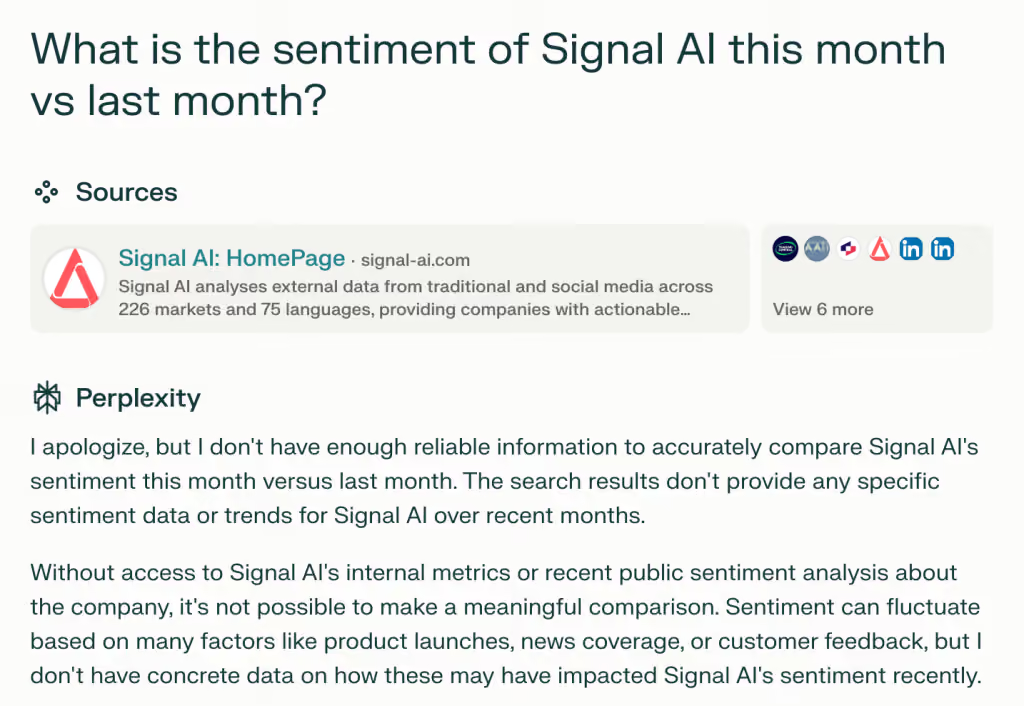
If you were to ask Perplexity AI, 'What are the main factors impacting your company’s reputation?’ it will give you an answer, but it won’t truly understand what this question means in the context of your use case.
Hallucinations and accuracy issues
Generative AI is precisely that; generative. It’s looking to find an answer based on previous patterns and generate something new.
To learn more about 'Uncovering the Black Box of AI,' watch our webinar here.

Copyright issues
Businesses using generative AI tools only are at risk for not guaranteeing responsible, high-quality data. On the other hand, Discriminative AI alone can determine exactly what information is relevant to the question, but can’t deliver an answer back to you in natural language. We highlighted the differences between generative and discriminative AI and how this can help communications professionals. Read more here.
Now that we’ve discussed the problems, what are the solutions? First, we need to understand what is RAG.
What is retrieval-augmented generation (RAG)?
While Generate AI models are trained to generate new information, what the RAG technique does is first retrieve the factually correct and accurate information based on inputted data (e.g., online documents, internal company data, or specialized knowledge bases), THEN generate a natural-language response based on the retrieved data. Essentially, like a good journalist, it asks the AI to gather information via its trusted sources before writing the story.
- Retrieval: The Discriminative AI model first retrieves relevant, up-to-date, and accurate data or documents based on the query or context.
- Generation: The Gen AI component of the solution then uses this retrieved information to generate a response that is both contextually appropriate and grounded in real-world facts.
At a very high level, RAG is a process of:
- User query: For example: “What’s the state of the diplomatic relations between Taiwan and Nauru?”
- Retrieval: Retrieval of documents and information related to the query
- Feeding context to the LLM: Providing any information that could be useful in answering the query
- Generate answer: Generating an answer that is factual and grounded in quality content.
This approach enables the model to answer questions based on the latest information, making it ideal for domains like customer support, content creation, and corporate communications, where accuracy and relevance are critical.
“So many of us interact with AI systems in a creative context. We interact with Gen AI, which is good at predicting the next pixel, the next word, the next note, or the next frame of video. In my world, I think a lot about discriminative AI, which is all about tagging and labeling. Is it Amazon the company or Amazon the rainforest, Nike the company or Nike the shoes? And what I think is going to be so important is using the combination of those two to figure out where the human voice continues to persist as we adopt AI in this discussion.” - Dan Gaynor for Page Up.
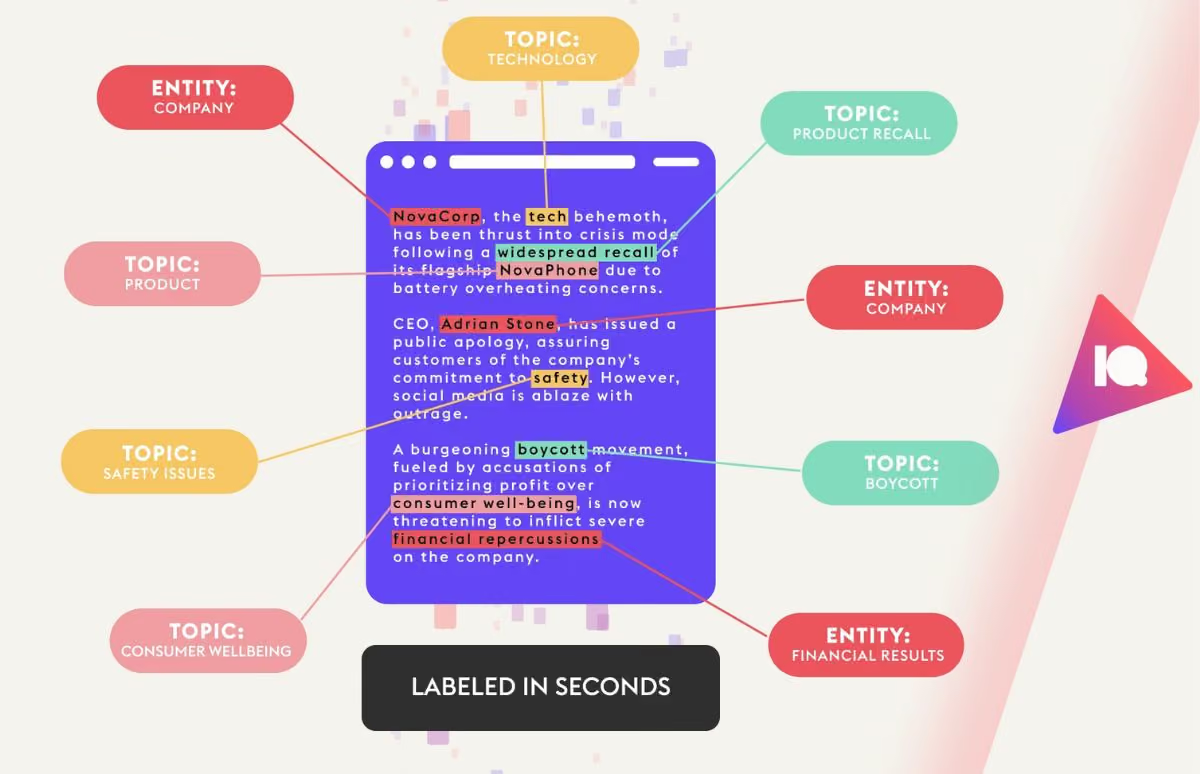
At Signal AI, we’ve been working for over a decade in retrieval tools and methods, using a combined approach of generative and discriminative AI: discriminative AI filters relevant information, using advanced entity-linking for accuracy; plus generative AI to connect the dots and provide natural language insights. By blending these elements, RAG offers a way to make AI more accurate, grounded in real-time information, and flexible across use cases.
5 reasons why RAG is the key to more accurate, context-aware AI
Accuracy and up-to-date responses
Since RAG solutions can pull from external sources, they’re not limited to the data the LLMs they use were initially trained on. This allows RAG to incorporate up-to-date information, making responses more accurate and relevant to the user’s needs and increasing the speed of insight. For example, Signal AI’s derived metadata allows our platform to generate insights on sentiment, topic analysis, and key stories.
Context-aware and domain-specific responses
Retrieval-augmented generation allows users to access specific information databases tailored to particular industries or use cases, whether it’s healthcare, finance, or technology in natural language.
For instance, in customer service, an AI system with RAG could pull from a company’s internal knowledge base or recent customer interactions, providing responses informed by company-specific details and policies.
Improved trustworthiness and content sourcing
Generative AI models sometimes hallucinate “facts” or create plausible-sounding but inaccurate responses. RAG reduces this by grounding responses in retrievable data. For instance, it can pull directly from trusted sources or reputable research, lending credibility to the responses. This is particularly valuable in high-stakes industries like law, healthcare, or finance, where factual accuracy is non-negotiable.
Scalability across use cases
RAG enables AI to work across different languages, domains, and types of queries because it can retrieve contextually relevant data to each request. This versatility makes it ideal for companies that need AI solutions across diverse functions and global markets.
Enhanced user experience
Users often want specific, relevant answers quickly. RAG can offer concise and precise responses without overwhelming users with irrelevant information, as it curates content based on relevance. This approach also supports personalized interactions, as the AI can retrieve and integrate user-specific details or past interactions, creating a more tailored experience.
Introducing Ask AIQ: The power of RAG at play

Introducing Signal AI’s Ask AIQ. Designed specifically for the needs of professionals like yourself - AIQ, the brain behind the Signal AI platform, combines several types of AI to get reliable and actionable insights.
Ask AIQ, now in development, introduces the first direct interaction with AIQ through an embedded conversational AI interface. Beyond mere data delivery, Ask AIQ puts actionable insights directly into your hands, eliminating manual data collection and interpretation. By aggregating relevant information into summaries, we can deliver fast, flexible strategic insights.
With more clarity, you’ll feel more confident.