








































































Welcome to Signal in the Noise, where we show you the real-world impact behind trending news.
Here’s what catches every comms leader off guard: your best numbers might not save your narrative. Take ZoomInfo in Q1 2026. They beat EPS and crushed revenue. Then they cut guidance. Stock crashed 36% after hours. Or Block in Q2: best margins ever posted, 25% profit growth. The only story the media ran was “profitable at the cost of people” because they laid off 40% of staff months prior.
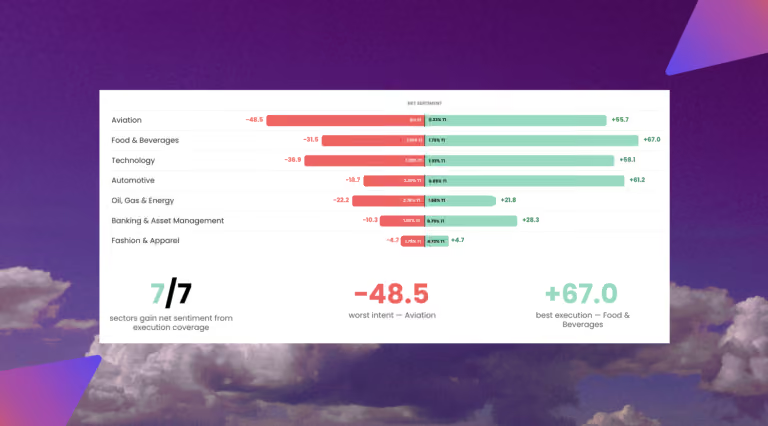
We analyzed 23,722 earnings articles from 2025-2026 YTD. When tech companies beat but cut guidance or announce layoffs, 43.6% of coverage turns negative. Finance companies? 7.7% for the same signals. That’s a 5.7x gap. The media doesn’t lead with your beat. They lead with what your forward signal says about your judgment.
The question we’re asking: When a company beats earnings but cuts guidance, what does the media cover?

Here’s the story: a 12% earnings beat combined with a guidance cut reads as “management lost control” to journalists. Stock drops 8-12% same day. But flip that beat to a guidance raise and sentiment jumps to 88% positive, stock up 4-8%. Same financial beat. Completely different narrative.
That’s because beating earnings proves you can execute. Your guidance proves you know what comes next. The media leads with the second one.
The numbers back this up. Cautious language on your earnings call? That’s a -42% sentiment hit. Announcing headcount cuts on the same day? -38%. But raising guidance? That’s +56%. The media doesn’t write about the earnings beat. They write about the gap between what you reported and what you’re signaling about the future.
The question to ask before earnings: does your forward signal make sense given your financial beat? If you’re crushing it operationally but cutting guidance, can you explain that gap? If not, can you reframe it?

Your sector determines how long the damage lasts. Tech sits in negative coverage for 7.2 days after beating earnings then cutting guidance. Finance recovers in 3.4 days. Retail takes 6.8 days. Why the gap? Tech operates on fragile trust. Layoffs still sting. AI risks feel fresh to journalists. Margins look precarious. Finance, by contrast, expects volatility as part of the business. Retail demand signals reset fast enough that old narratives fade quickly.
Here’s the critical part: Tech has memory. One guidance cut can echo through the entire earnings cycle. Recovery isn’t automatic. You need proof that leadership has control. Tech comms teams should have 2-week counter-narratives ready. Finance can operate on 5-day windows. Retail needs sustained messaging through the quarter.
By sector, media priorities shift. Tech earnings trigger scrutiny over AI ROI and strategic direction. Retail coverage focuses on same-store sales and inventory signals. Finance emphasizes margin framing: “temporary headwind” plays better than “structural shift.” Energy ties every earnings to ESG. Mention rising emissions and activist coverage arrives within 24 hours.

Not all earnings damage is equal. Executive departures announced at earnings carry 6 weeks of negative sentiment. Guidance cuts: 3-4 weeks. Layoff announcements timed with earnings: 4-6 weeks. A guidance raise closes the wound in 7 days.
Why? Departures read as credibility failures. Headcount cuts signal poor judgment. Guidance raises work because they are the counter-narrative.
Here’s what catches teams off guard: recovery isn’t automatic. Silence carries negative sentiment forward: into the next analyst call, the next preview, the next conference. That narrative compounds. You need affirmative proof: new products, strategic hires, clearer visibility.
Before filing earnings, prep your forward signal and build your counter-narrative. Know which journalists will test hardest. Prep your CFO for their specific questions. The prepared companies recover.
Your reputation doesn’t hinge on beating earnings. It hinges on alignment. When your forward signal matches your financial results, the media writes an execution story that carries momentum. When they don’t align, the media writes about the gap instead. That’s where your narrative breaks.
The teams that win earnings season aren’t the ones with the best numbers. They’re the ones who understand what their media will read into before earnings day and who build their narrative around that alignment, not the beat itself. The story lives in the gap between what you report and what you’re signaling comes next.
Resource round-up:
Methodology:
Dataset: 23,722 earnings articles from 2025 YTD across six sectors, 5,000+ outlets. Built using Signal AI MCP connector.
Filters: $2B+ market cap companies, after-market close announcements, 100+ media mentions minimum. Excluded M&A, product launches, concurrent executive changes, IPOs.
Sentiment Scoring: 0-100 scale using keyword signals (guidance language, layoff mentions, margin commentary) + contextual analysis. Positive: execution/upside/clarity. Negative: misses/cuts/credibility gaps. Neutral: factual recap.